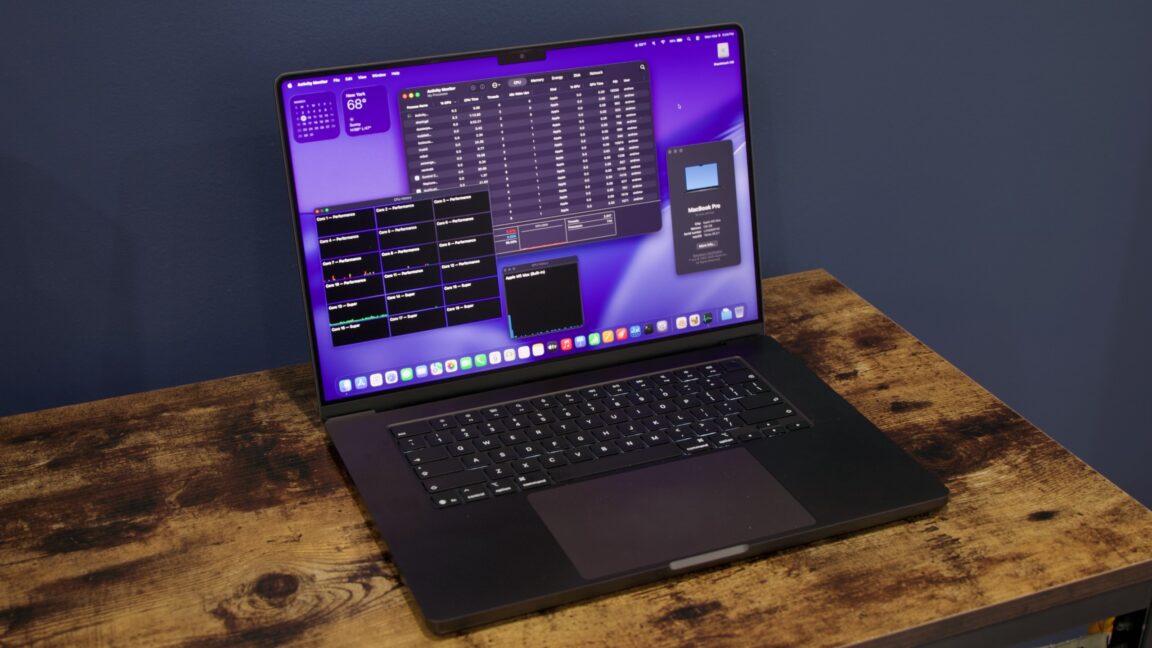
"The M5 Pro and M5 Max are no longer monolithic chips with all the CPU and GPU cores and everything else packed into a single silicon die. Using an 'all-new Fusion Architecture' like the one used to combine two Max chips into a single Ultra chip, Apple now splits the CPU cores (and other things) into one piece of silicon, and the GPU cores (and other things) into another piece of silicon."
"The other big change is that neither of these chips uses Apple's 'efficiency' CPU cores anymore. All of the M5 family's large high-performance cores are now called 'super' cores as of macOS 26.3.1, including the ones that originally launched as 'performance' cores in the regular M5 last fall."
"M5 Pro and M5 Max both use the same 18-core CPU die, but Pro uses a 20-core GPU die, and Max gets a 40-core GPU die. Because the memory controller is also part of the GPU die, the Max chip still offers more memory bandwidth and supports higher memory configurations than the Pro one does."
Apple's M5 Pro and M5 Max chips represent significant architectural changes from previous generations. Rather than monolithic designs, these chips now use a modular Fusion Architecture that separates CPU cores onto one die and GPU cores onto another, then packages them together. Both Pro and Max share an 18-core CPU die, while Pro features a 20-core GPU die and Max features a 40-core GPU die. A major change is the elimination of efficiency cores in these models. Apple has renamed its high-performance cores to 'super' cores across the M5 family, while introducing new 'performance' cores in the Pro and Max variants that differ from traditional efficiency cores.
Read at Ars Technica
Unable to calculate read time
Collection
[
|
...
]