"Computing today is digital, but analog has a future. Exponential advances in digital hardware have both driven and benefited from the rise of artificial intelligence (AI), but its escalating energy and latency demands push digital specialization to its limits8. Analog approaches-leveraging optics1,2,3,4,9, analog electronic crossbars5,6 and quantum annealers7-promise orders-of-magnitude gains in efficiency and speed. Existing hardware demonstrations focus either on AI inference1,2,3,10,11,12,13, which accounts for 90% of energy in commercial deployments14, or combinatorial optimization7,15, but none efficiently accelerate both on the same analog hardware."
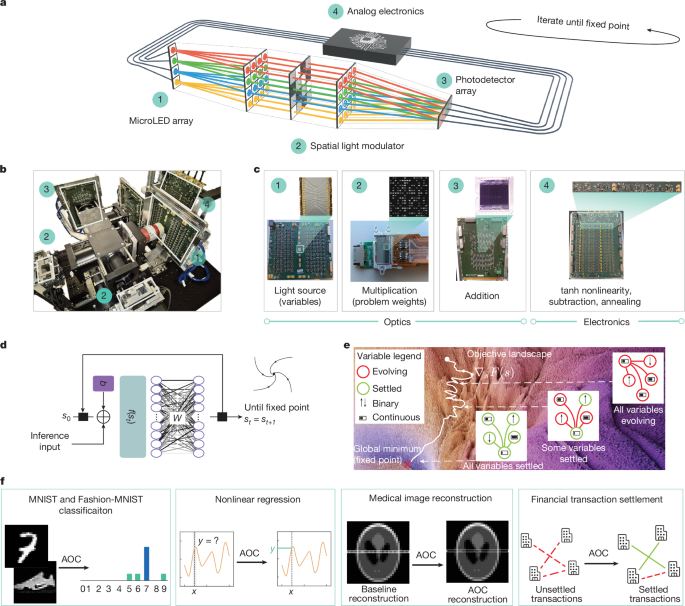
"Here we introduce the analog optical computer (AOC), a non-traditional computing platform designed for both AI inference and combinatorial optimization. By combining optical and analog electronic components within a feedback loop, the AOC rapidly performs a fixed-point search without digital conversions. In each loop iteration of approximately 20 ns, optics handle matrix-vector multiplications, whereas analog electronics perform nonlinear operations, subtraction and annealing (Fig. 1a-c). Over multiple iterations, the fixed-point nature of the AOC enhances noise robustness, which is essential for analog hardware."
Digital computing faces rising energy and latency limits as AI scales, motivating analog approaches that promise orders-of-magnitude gains in efficiency and speed. The analog optical computer (AOC) integrates optics and analog electronics in a feedback loop to perform fixed-point searches without digital conversions. Each approximately 20 ns loop executes optical matrix–vector multiplications while analog electronics apply nonlinearities, subtraction and annealing. Key hardware elements include a microLED array as activations, a spatial light modulator storing weights, a photodetector array converting optical signals, and analog circuitry implementing computation. The fixed-point iterative operation enhances noise robustness and enables acceleration of both AI inference and combinatorial optimization.
#analog-optical-computing #ai-inference-acceleration #combinatorial-optimization #fixed-point-feedback-architecture
Read at Nature
Unable to calculate read time
Collection
[
|
...
]