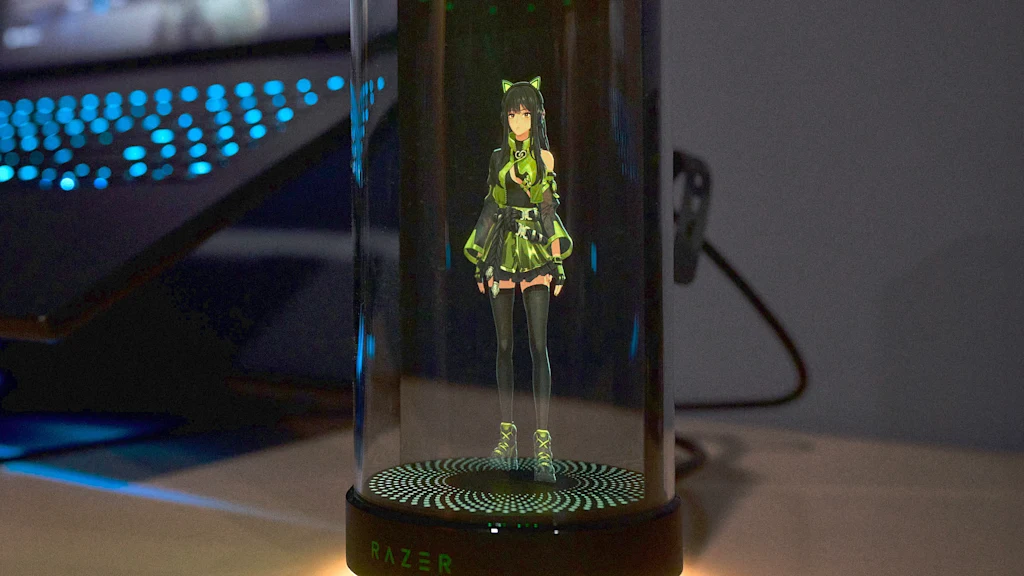
Razer unveiled Project AVA, a small glass cylinder containing a 5.5-inch animated desk companion that interacts, coaches, or offers gaming advice using xAI's Grok. The device uses "PC Vision Mode" to watch the user's screen so the 3D inhabitant can provide real-time commentary, track mood, and simulate presence as a persistent physical companion. Recent voice AI developments added natural pauses and breathing, increasing conversational realism. Users often prefer voice-only interfaces for emotional venting because they feel safer without a face present. Neuroscience suggests humans are hardwired for face-to-face interaction via mirror neurons, which remain less active during voice-only chats.
"When OpenAI's introduced ChatGPT 4o voice chats in the summer of 2024, humanity entered a new form of computer interaction. Suddenly, we could interact with AI voices that were smart and natural enough for humans to maintain a conversation. Since then, we have seen other voice AIs like Gemini Live, which introduce pauses, breathing, and other elements that cross the uncanny valley and allow many to suspend disbelief and even form a bond with these assistants."
"Research has shown that for deep emotional venting, users currently prefer voice-only interfaces because they feel safer and less judgmental. Without a face to scrutinize, we avoid the social anxiety of being watched. However, some neuroscientists argue that this preference may just be a temporary work-around for bad technology. Our brains are evolutionarily hardwired for face-to-face interaction. The "Mirror Neuron System" in our brains-which allows us to feel empathy by watching others-remains largely dormant during voice-only chats."
Read at Fast Company
Unable to calculate read time
Collection
[
|
...
]