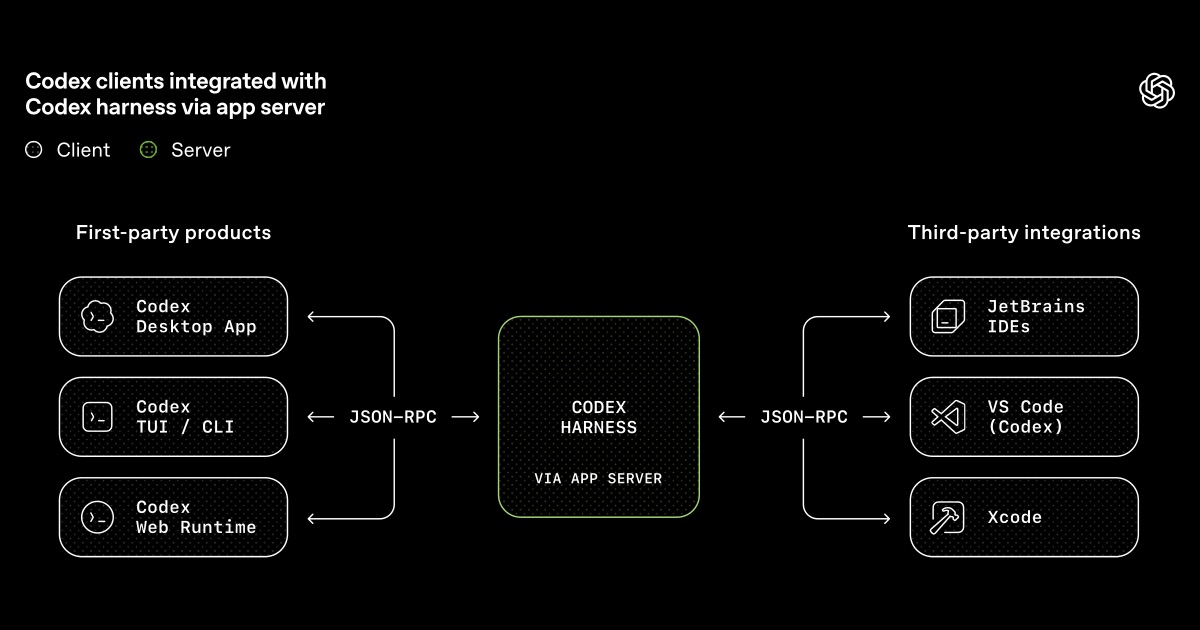
"The Codex App Server's internal architecture: the stdio reader and Codex message processor translate client JSON-RPC requests into Codex core operations and transform internal events back into stable, UI-ready notifications (Source) To model this, OpenAI designed three conversation primitives. An Item is the atomic unit of input or output with an explicit lifecycle of "started", optional streaming "delta" events, and "completed"."
"This can be a user message, an agent message, a tool execution, an approval request, or a diff. A Turn groups the sequence of items produced by a single unit of agent work, initiated by user input. A Thread is the durable container for an ongoing session, supporting creation, resumption, forking, and archival with persisted event history so clients can reconnect without losing state."
The Codex App Server implements a bidirectional protocol that separates the agent core from client surfaces, enabling a single stable API across CLI, VS Code, web, macOS, and third-party IDEs. The design models interactions with three primitives: Item (atomic input/output with lifecycle and streaming deltas), Turn (the sequence of items from one unit of agent work), and Thread (a durable session container with persisted history that supports resume, fork, and archive). The architecture translates JSON-RPC into core operations, supports server-initiated requests for approvals, and produces UI-ready notifications for clients to reconnect without losing state.
Read at InfoQ
Unable to calculate read time
Collection
[
|
...
]