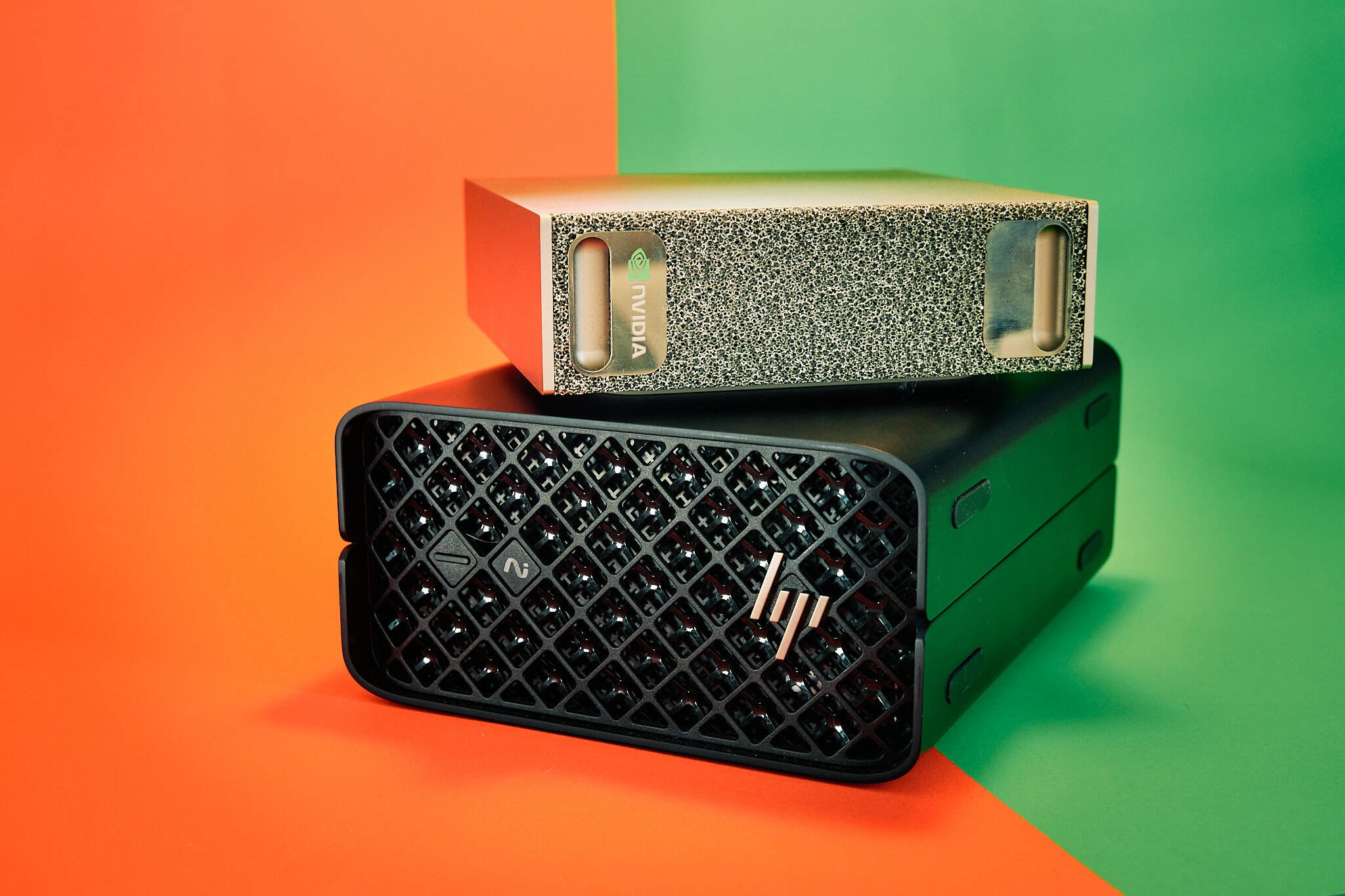
Local GenAI development remains important despite large datacenter clusters handling most training and inference. Historically, effective local prototyping required high‑end, multi‑GPU workstations costing tens of thousands of dollars. Nvidia's GB10‑based DGX Spark offers 128 GB of video memory in a compact system capable of running many AI workloads. AMD and Apple provide unified memory systems shared between CPU and GPU, attracting developers. AMD's Ryzen AI Max+ 395 APU ("Strix Halo") costs about half to three‑quarters of the Spark and uses a ROCm/HIP stack similar to datacenter products, easing desktop‑to‑datacenter migration. HP's Z2 Mini G1a highlights differences in chassis size, power delivery, and cooling.
"AMD's Ryzen AI Max+ 395 APU, which for the sake of brevity we're simply going to refer to as "Strix Halo" from here on out, is particularly interesting. In addition to selling for between three-quarters and half the cost of the Spark, Strix Halo builds on roughly the same ROCm and HIP software stack as the company's datacenter products. This provides a clearer, though not necessarily seamless migration path from desktop to datacenter."
"To see how Strix Halo stacks up against the Spark, HP sent over its Z2 Mini G1a workstation so we could find out how each of these little boxes of TOPS fares in a variety of AI workloads, ranging from single-user and batched inference to fine-tuning and image generation. The first thing you'll notice is the HP is significantly larger than the Spark."
Read at Theregister
Unable to calculate read time
Collection
[
|
...
]