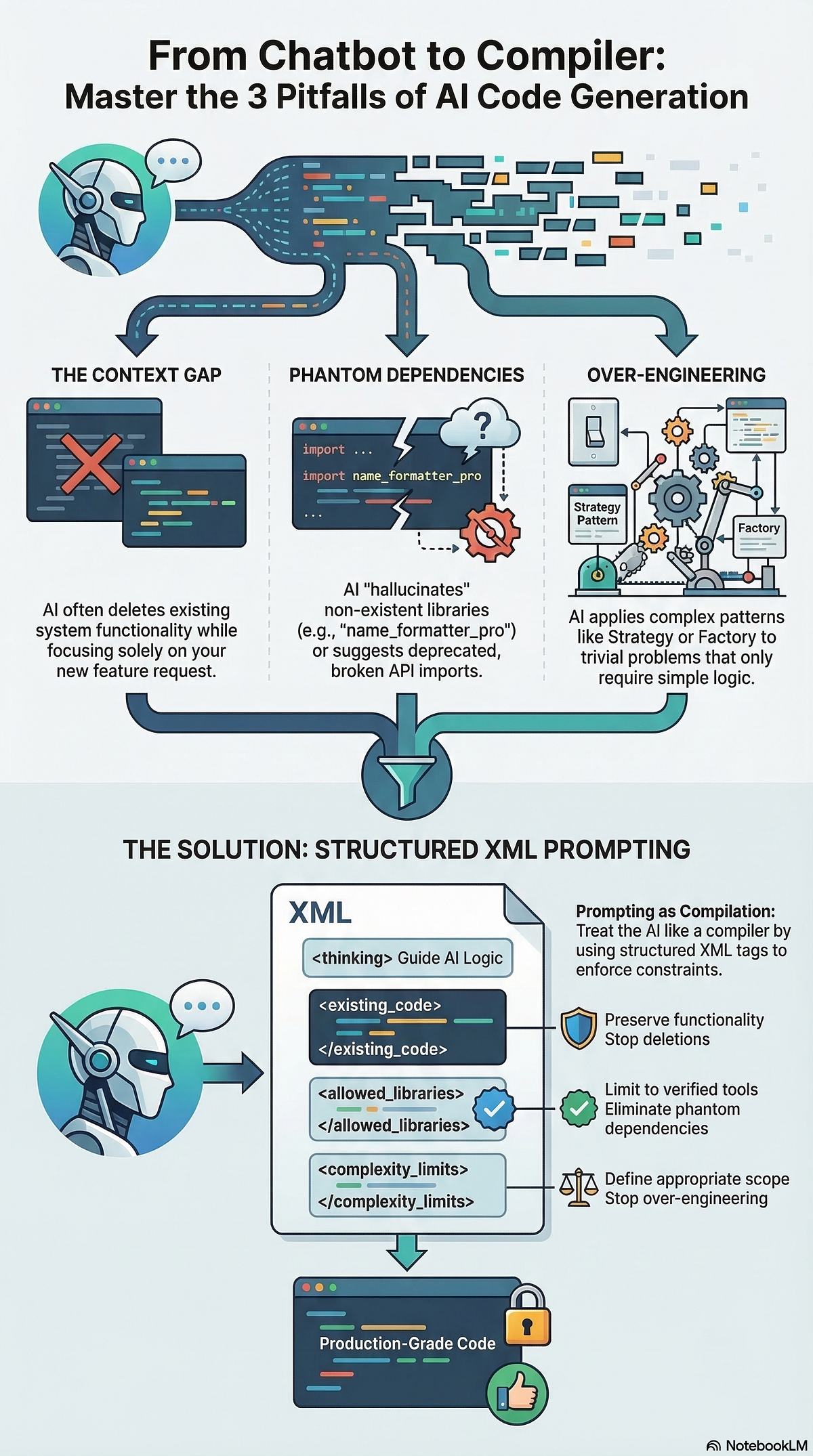
Software development requires a fundamental mindset shift in how engineers interact with Large Language Models. Rather than viewing AI as a conversational tool, professionals must treat it as a compiler that processes probabilistic intent. AI-generated code exhibits distinct defects that differ from human errors—they are often structural and hallucinatory in nature. A critical risk called the Context Gap occurs when LLMs lose sight of existing system functionality while focusing on new requests. This phenomenon, rooted in token-prediction mechanics, represents one of the most insidious challenges in AI-assisted coding. Technical educators advocate for implementing a dedicated diagnostic phase in modern engineering workflows to proactively identify machine-specific patterns before code integration.
"To build resilient, professional-grade applications, engineers must undergo a psychological shift: we must stop treating AI as a "chatbot" and start treating it as a "compiler." While a compiler enforces strict syntax and type safety, an AI "compiler" processes probabilistic intent. This fundamental difference means that AI-generated code possesses a distinct defect profile."
"The Context Gap (known in Polish as Luka Kontekstowa) is one of the most insidious risks in AI-assisted coding. It occurs when the model focuses so intensely on a new request that it loses sight of the system's broader existing functionality. Because LLMs operate on a token-prediction basis rather than a..."
Read at Medium
Unable to calculate read time
Collection
[
|
...
]