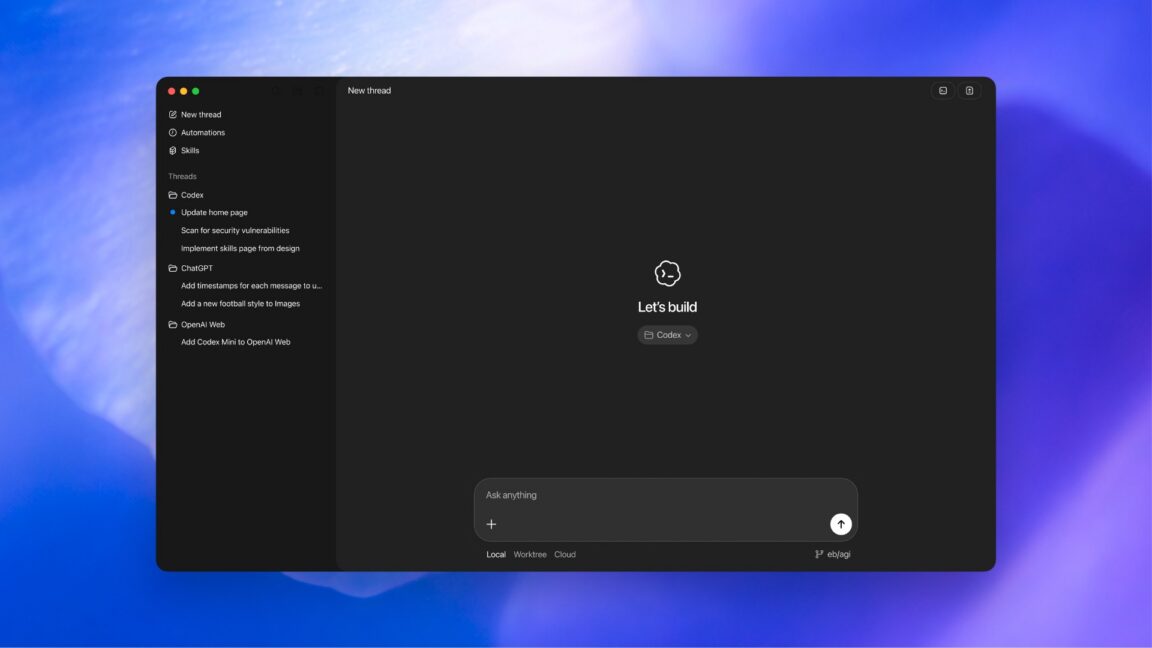
"Today, OpenAI announced GPT-5.3-Codex, a new version of its frontier coding model that will be available via the command line, IDE extension, web interface, and the new macOS desktop app. (No API access yet, but it's coming.) GPT-5.3-Codex outperforms GPT-5.2-Codex and GPT-5.2 in SWE-Bench Pro, Terminal-Bench 2.0, and other benchmarks, according to the company's testing. There are already a few headlines out there saying "Codex built itself," but let's reality-check that, as that's an overstatement."
"The domains OpenAI described using it for here are similar to the ones you see in some other enterprise software development firms now: managing deployments, debugging, and handling test results and evaluations. There is no claim here that GPT-5.3-Codex built itself. Instead, OpenAI says GPT-5.3-Codex was "instrumental in creating itself." You can read more about what that means in the company's blog post. But that's part of the pitch with this model update-OpenAI is trying to position Codex as a tool that does more than generate lines of code."
OpenAI released GPT-5.3-Codex, a frontier coding model accessible via command line, IDE extension, web interface, and a new macOS desktop app, with API access planned. GPT-5.3-Codex outperforms prior GPT-5.2 models on SWE-Bench Pro, Terminal-Bench 2.0, and other benchmarks based on OpenAI's testing. Headlines claiming the model 'built itself' overstate the case; there is no claim that it literally built itself, though OpenAI describes it as 'instrumental in creating itself.' The model targets full software lifecycle tasks—debugging, deploying, monitoring, tests, PRDs, user research and metrics—with features for mid-task steering and frequent status updates.
Read at Ars Technica
Unable to calculate read time
Collection
[
|
...
]