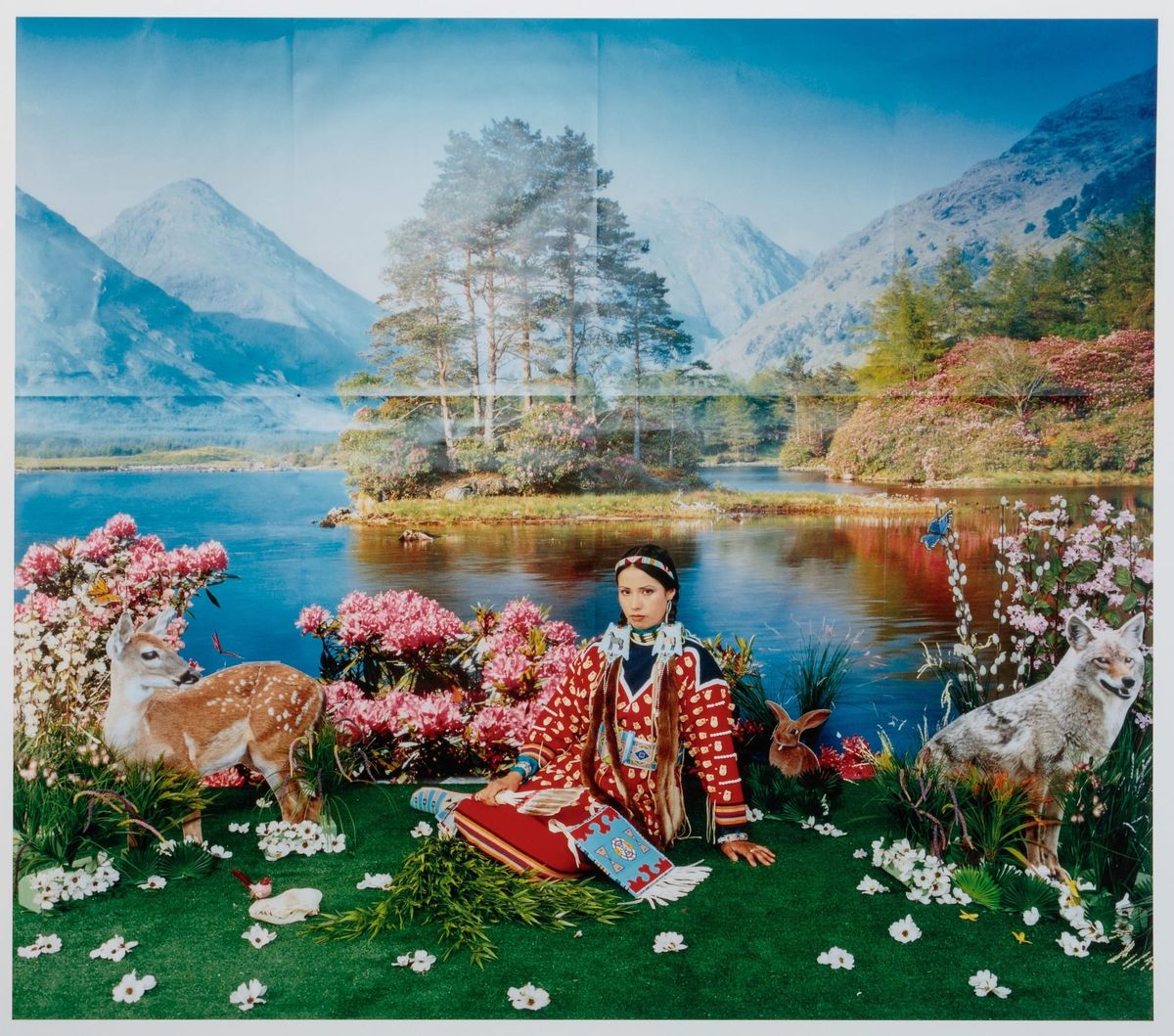
A Kind of Paradise at Museum Rietberg brings together twenty artists who treat colonial-era photography as material that can be unsettled, reworked, and reclaimed. The works reject colonial photographs as sealed historical records and instead use contradictions within the archive as creative fuel. Four approaches structure the exhibition: Shapeshifters, Confrontation, Care, and In the Photo Fantastic. Shapeshifters addresses missing archives by building counter-archives that treat memory as a living practice shaped by viewers. Confrontation targets mass-circulated images that codified racial hierarchies, using collages and interventions to expose the colonial gaze and restore dignity and agency. Care and In the Photo Fantastic extend these strategies through ongoing, relational engagement with photographic histories.
"A Kind of Paradise, on view at Museum Rietberg in Zurich, brings together twenty artists who treat colonial‑era photography not as a sealed historical record but as material that can be unsettled, reworked, and reclaimed."
"The show unfolds across four sections - Shapeshifters, Confrontation, Care, and In the Photo Fantastic - each offering a different tactic for dealing with images that have shaped, distorted, or erased histories. Rather than smoothing over the contradictions of the colonial archive, the artists lean into them. They cut, annotate, stitch, and reimagine photographs that once claimed to define entire cultures."
"In Shapeshifters, the absence of photographic archives becomes a generative force. Many communities outside Europe have little visual documentation of their own pasts, a void created by extraction, displacement, and the uneven spread of early photography. Artists such as Rosana Paulino, Cédric Kouamé, and Dinh Q. Lê respond by building their own counter‑archives. Their works are layered and tactile, insisting that memory is not a fixed record but a living practice that shifts depending on who is looking."
"Confrontation turns to the mass‑produced images that circulated through postcards, magazines, and ethnographic albums. These pictures helped codify racial hierarchies and fantasies of otherness. Artists including Omar Victor Diop, Yuki Kihara, Frida Orupabo, and Dimakatso Mathopa dismantle these visual clichés with precision. Their collages and interventions expose the mechanics of the colonial gaze while reclaiming the dignity and agency of the people pictured."
Read at Hyperallergic
Unable to calculate read time
Collection
[
|
...
]