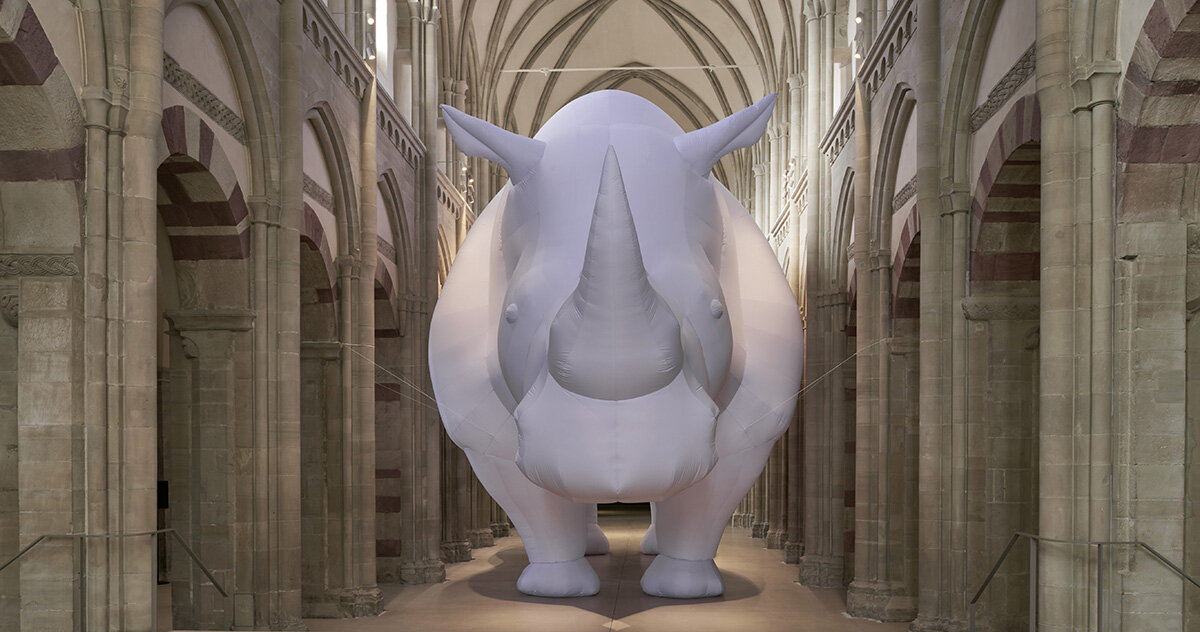
"The Rhinoceros in the Room, an inflatable installation by Itamar Gov, occupies the central volume of Kunstmuseum Magdeburg in Magdeburg, Germany with a single, overwhelming gesture. Installed inside the former monastery church that houses the museum, the project places a larger than life rhinoceros directly in the nave, its bulk stretching from aisle to aisle and rising toward the Romanesque vaults, so that the animal becomes the primary spatial condition of the building rather than an object within it."
"Approaching the exhibition, visitors pass through stone arcades and patterned floors before meeting the pale mass of the creature head on. The architecture remains visible in fragments around its edges. Columns appear cropped. Sightlines shorten. Sound travels differently. The installation shifts the way the church is read, turning a familiar heritage interior into a tight, compressed environment shaped by proximity to an immense body."
"Artist Itamar Gov's rhinoceros at Kunstmuseum Magdeburg has a matte, almost chalky surface that absorbs light and softens detail. From a distance it reads as a simplified volume, closer to a model or prototype than a naturalistic sculpture. Up close, folds, legs, and horn emerge with quiet precision. The animal stands still, heavy and grounded, yet its size creates a subtle tension, as if any movement would set the entire hall in motion."
"Music circulates through the gallery as a multi channel composition, filling the church from every direction. Eight cellos and voices drift between recognizable melodies and lullaby tones, then veer into darker passages. The sound seems to slide along the stone walls and settle into the floor, guiding the pace of walking and encouraging longer pauses. Visitors listen as much as they look."
An inflatable rhinoceros by Itamar Gov occupies the central nave of Kunstmuseum Magdeburg, spanning aisle to aisle and rising toward the Romanesque vaults, making the animal the primary spatial condition of the former monastery church. Visitors pass stone arcades and patterned floors before confronting the pale mass, with architecture visible only in fragments as columns crop and sightlines shorten. The sculpture has a matte, chalky surface that absorbs light and simplifies form, revealing folds, legs, and horn with quiet precision up close. Eight cellos and voices form a multi-channel composition that circulates through the gallery, sliding along stone walls and settling into the floor, guiding pace and encouraging pauses.
Read at designboom | architecture & design magazine
Unable to calculate read time
Collection
[
|
...
]