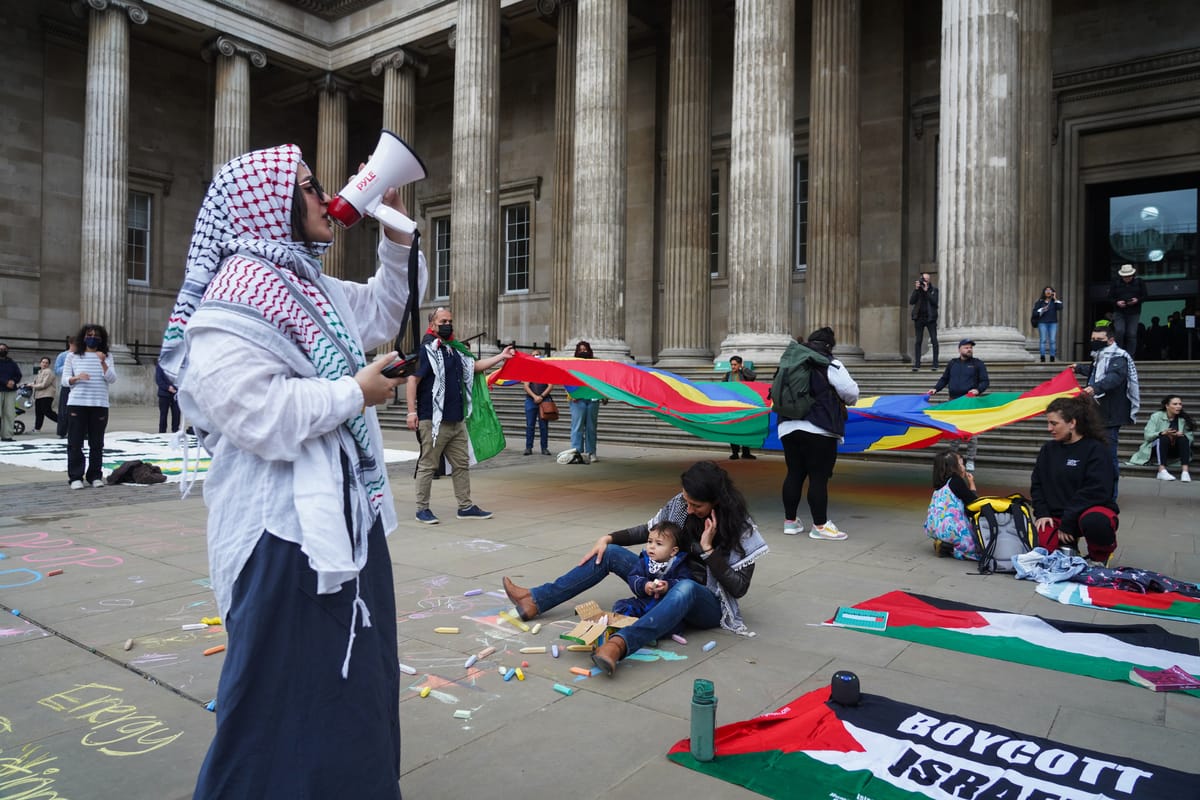
""Some labels and maps in the Middle East galleries have been amended to show ancient cultural regions, which is more relevant for the southern Levant in the later second millennium BC," a British Museum spokesperson said in an email to Hyperallergic. The museum, however, denied removing the word "Palestine" from its displays altogether, as initially reported by the on Saturday."
""It has been reported that the British Museum has removed the term Palestine from displays," the spokesperson said. "It is simply not true. We continue to use Palestine across a series of galleries, both contemporary and historic." "We use the UN terminology on maps that show modern boundaries, for example, Gaza, West Bank, Israel, Jordan, and refer to 'Palestinian' as a cultural or ethnographic identifier where appropriate," the spokesperson continued."
"The British Museum acknowledged that it had updated certain displays in its Middle East Galleries with "terms such as 'Canaan,' the Biblical Hebrew name for the Southern Levant region,amid news reports accusing the institution of erasing Palestinian history." Canaan refers to an ancient region that encompassed modern-day Palestine, Israel, Syria, and Jordan. According to some academic sources, the term first emerged around 1500 BCE, and the region's earliest inhabitants settled in Jericho in the modern Occupied West Bank."
The British Museum updated certain labels and maps in its Middle East galleries to show ancient cultural regions, including the use of the Biblical Hebrew term Canaan for the southern Levant. Canaan is described as an ancient region covering modern-day Palestine, Israel, Syria, and Jordan, with origins cited around 1500 BCE and early settlement in Jericho. The museum denied removing the term Palestine from displays and stated that Palestine continues to appear across contemporary and historic galleries. The museum said it uses UN terminology for modern boundaries and refers to 'Palestinian' as a cultural or ethnographic identifier where appropriate. A legal group, UK Lawyers for Israel, celebrated the revisions and claimed they followed its requests.
Read at Hyperallergic
Unable to calculate read time
Collection
[
|
...
]