"The work introduces a shade of black that is deep, smooth, glossy, and seemingly endless - absorbing so much light that the white walls appear dull. Viewers may or may not decide to decode the cryptic iconography. More importantly, "The People" and other works in the survey consider the relationship that black and white have to each other: One is the absence of color, the other is all colors, and together they reinforce each other's fictions."
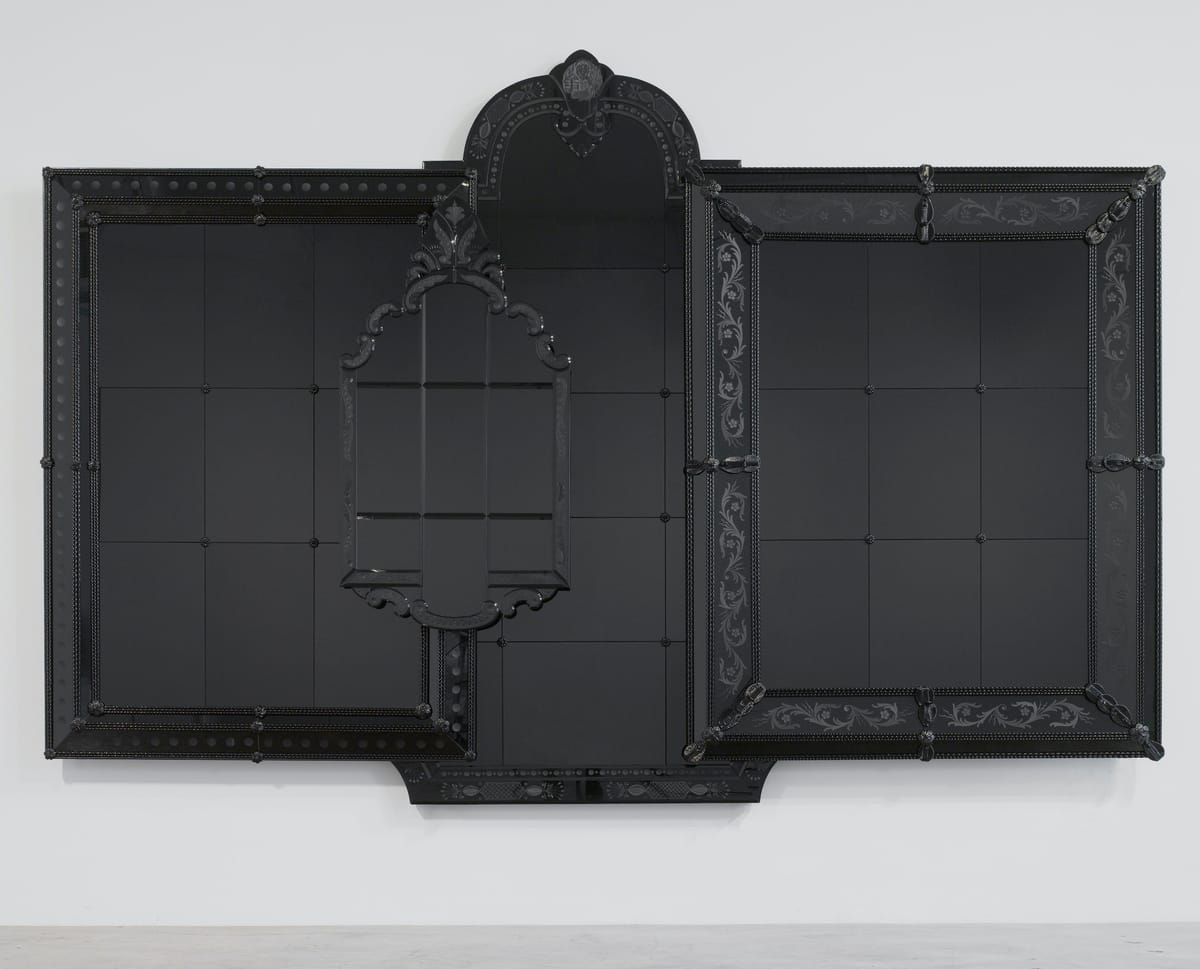
"Three glass chandeliers in the exhibition - "Dramatis Personae" (2022), "Eclipse" (2017), and "No Way But This" (2013) - and two Rococo-style mirrors adorn a wall in the first section, punctuated by black glass droplets. Rococo decorative arts are known for being seductively ornate. For Wilson, the three intricate floret chandeliers, one in black, one in white, and one in both, recall the interracial marriage of Desdemona and Othello in Shakespeare's ."
A black-and-white canvas depicting a trident, stars, a swan, and a half-circle gear with a machete anchors the entry, presenting a deep glossy black that soaks up light and dulls surrounding white walls. The exhibition examines the mutual reinforcement of black and white as oppositional fictions, treating one as absence and the other as totality of color. Murano glass chandeliers and Rococo-style mirrors appear alongside caryatid references and European decorative objects. Ornate chandeliers in black, white, and mixed tones evoke miscegenation and the social tensions surrounding interracial marriage as staged in historical drama. The works probe manufactured images, colonial shadows, and contemporary distortions of identity.
Read at Hyperallergic
Unable to calculate read time
Collection
[
|
...
]