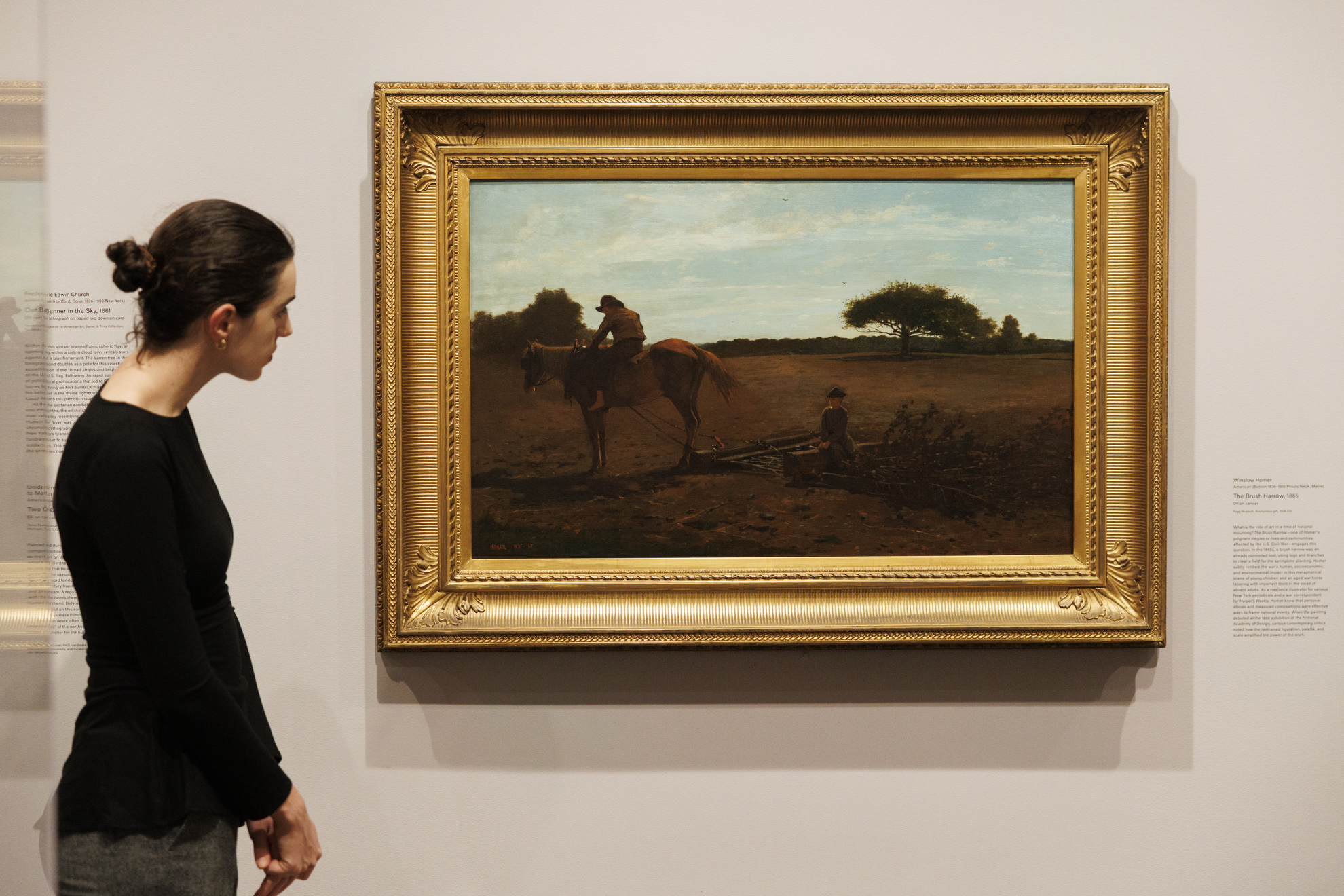
Winslow Homer’s The Brush Harrow depicts two young boys, a horse, and a harrow against an arid landscape. Homer painted the scene in 1865 as the Civil War ended. The image evokes somber isolation and the absence of adult men, with children performing agricultural labor previously done by parents and relatives. A horse in the painting appears riderless and bears the letters "US," indicating a Union military brand. Homer worked as a Civil War correspondent for Harper's Weekly and produced several wartime works that reflect the human costs of the conflict, including The Veteran in a New Field and Prisoners from the Front.
"At first sight, Winslow Homer's " The Brush Harrow," which depicts two young boys, a horse, and a harrow against an arid landscape, evokes a feeling of somber isolation - but it's hard to pinpoint why. During a talk by curator Horace D. Ballard at the Harvard Art Museums on Jan. 29, visitors learned that Homer painted the scene in 1865, as the Civil War was ending, making the emotional underpinnings of the work clearer."
""One in five young men between the ages of 16 and 40 disappeared, went missing, or died during the Civil War," said Ballard, the Theodore E. Stebbins, Jr., Curator of American Art, delivering the first talk in a special series marking the 250th anniversary of the signing of the Declaration of Independence. "So, the poignancy of this work is that children are doing the work that parents, siblings, uncles, and aunts used to do.""
"Like other Homer works from the period - including "The Veteran in a New Field" (1865), and "Prisoners from the Front" (1866) - "The Brush Harrow" is a reminder of the costs of war. Ballard picked up on this theme, noting the depiction of children "doing the work that no one should ask children to do," and a horse that "came back from the war without his rider.""
Read at Harvard Gazette
Unable to calculate read time
Collection
[
|
...
]