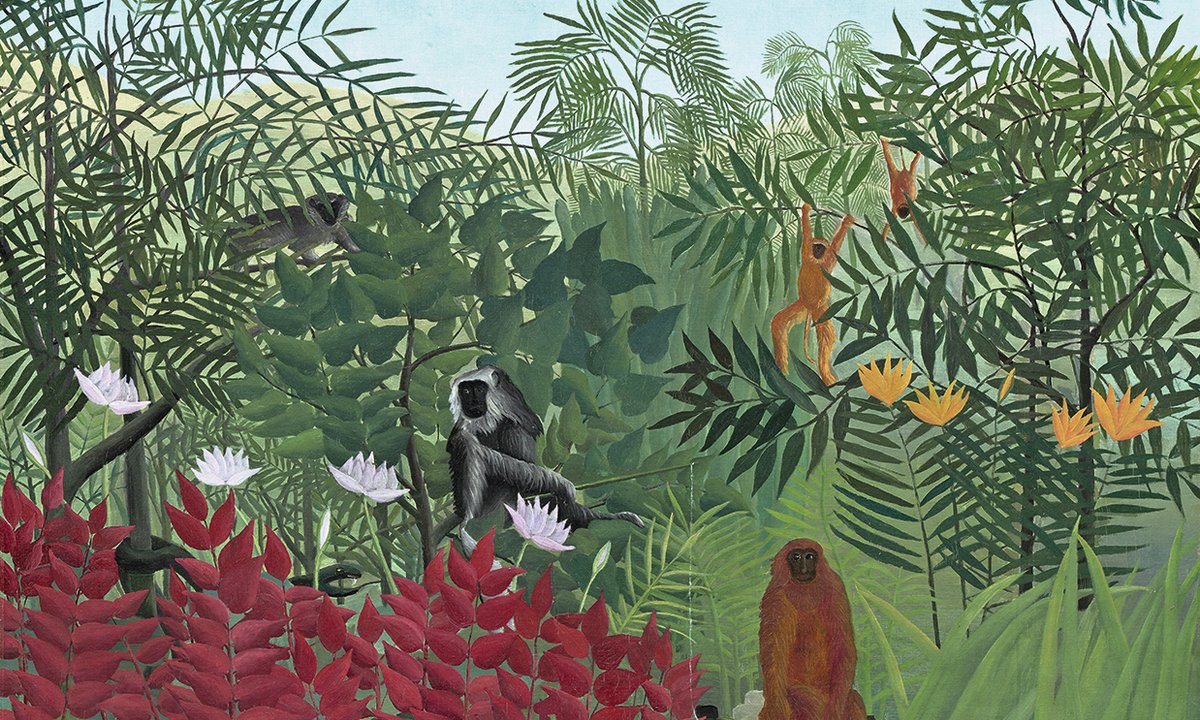
Henri Rousseau retired early from a toll-booth job in Paris to pursue painting and endured persistent poverty. He was a self-taught painter who suffered financial hardship and legal trouble, including a 1907 bank-fraud trial in which his lawyer presented his untutored paintings as evidence of naivety. Posthumous supporters promoted a myth of unworldly innocence around him and nicknamed him "Le Douanier." His market expanded, with collectors such as Albert C. Barnes and dealer Paul Guillaume assembling major holdings. Barnes paid 45,000 francs for a Rousseau in 1923. A major exhibition reunites the Barnes and Guillaume collections, enabled by a 2023 court decision allowing loans outside fixed ensembles.
""I never saw such poverty as I saw in Rousseau's studio," recalled the artist Max Weber, one of the first patrons of the self-taught painter Henri Rousseau (1844-1910). Having retired early from a job in the toll booths of Paris to pursue his dream of being an artist, Rousseau faced constant money struggles. In 1907, he was embroiled in bank fraud and put on trial. Defending him as a simple soul who was duped, Rousseau's lawyer deployed his untutored paintings as proof of his "naivety"."
""This myth of unworldly innocence was spread after his death by the artists, critics, dealers and collectors who championed the amateur they nicknamed "Le Douanier" (the customs officer). His reputation and market were booming by 1923, when the US collector Albert C. Barnes paid the dealer Paul Guillaume 45,000 francs (plus commission) for his first Rousseau-on a par with prime works by Henri Matisse or Pablo Picasso.""
Read at The Art Newspaper - International art news and events
Unable to calculate read time
Collection
[
|
...
]