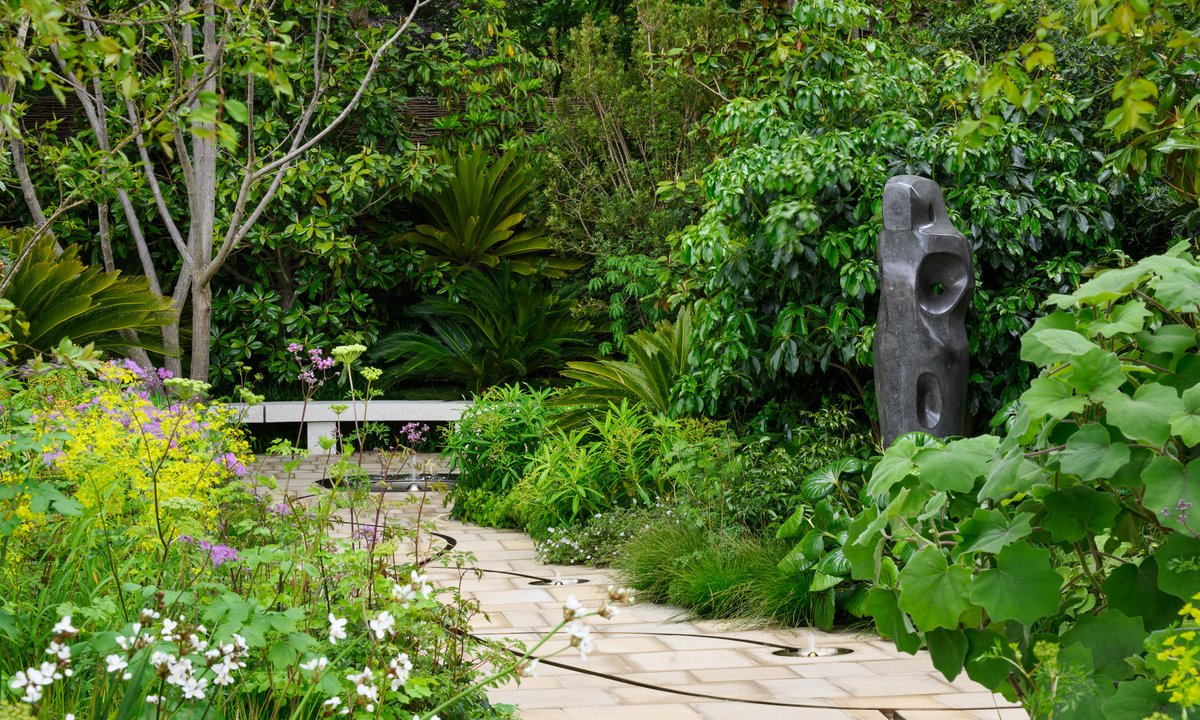
A Tate Britain garden preview will be shown at the RHS Chelsea Flower Show in west London, featuring key sculptures from the Tate collection. The garden is designed as a taster of the forthcoming Clore Garden at Tate Britain, scheduled for completion in 2027, and will be transferred to Tate Britain on Millbank after the show. Bicentric Form, a 1949 Barbara Hepworth sculpture, sits at the center of the garden and is paired with bold textures and forms to contrast the sculpture’s dark, smooth stone. The planting includes species suited to central London’s now virtually frost-free conditions and rising temperatures, such as Mediterranean fig trees and Schefflera shweliensis, plus a wildlife pond. Recycled materials from the Millbank site are reused as paving and a central bench is cast from reused materials.
"The Tate Britain Garden offers "a taster of the forthcoming Clore Garden at Tate Britain", designed by Tom Stuart-Smith and scheduled for completion in 2027. After the show, the garden will be transferred to Tate Britain on Millbank. At the heart of the RHS Chelsea garden is Bicentric Form, a 1949 sculpture by Barbara Hepworth that was the first work Tate acquired by the artist."
""Hepworth was very progressive in showing her work in a garden context and we are using very bold textures and forms as a counterpoint to the dark, smooth stone of the sculpture. I think she would approve," says Stuart-Smith in a statement."
"Tate Britain director Alex Farquharson tells The Art Newspaper that the "sculptures [featured in the final garden] will go from classic modern to contemporary; they will be [located] there for years and years. In each case, there will be this beautiful dialogue with planting. The whole garden will reframe the building." He says that the museum's Millbank entrance will close shortly."
""Previewing plant species that will be seen in the Clore Garden, The Tate Britain Garden showcases planting that thrives in central London's now virtually frost-free environment and rising temperatures, such as Mediterranean fig trees and foliage like Schefflera shweliensis, native to the Eastern Himalayas," says a Tate statement. A wildlife pond also forms part of the design."
Read at The Art Newspaper - International art news and events
Unable to calculate read time
Collection
[
|
...
]