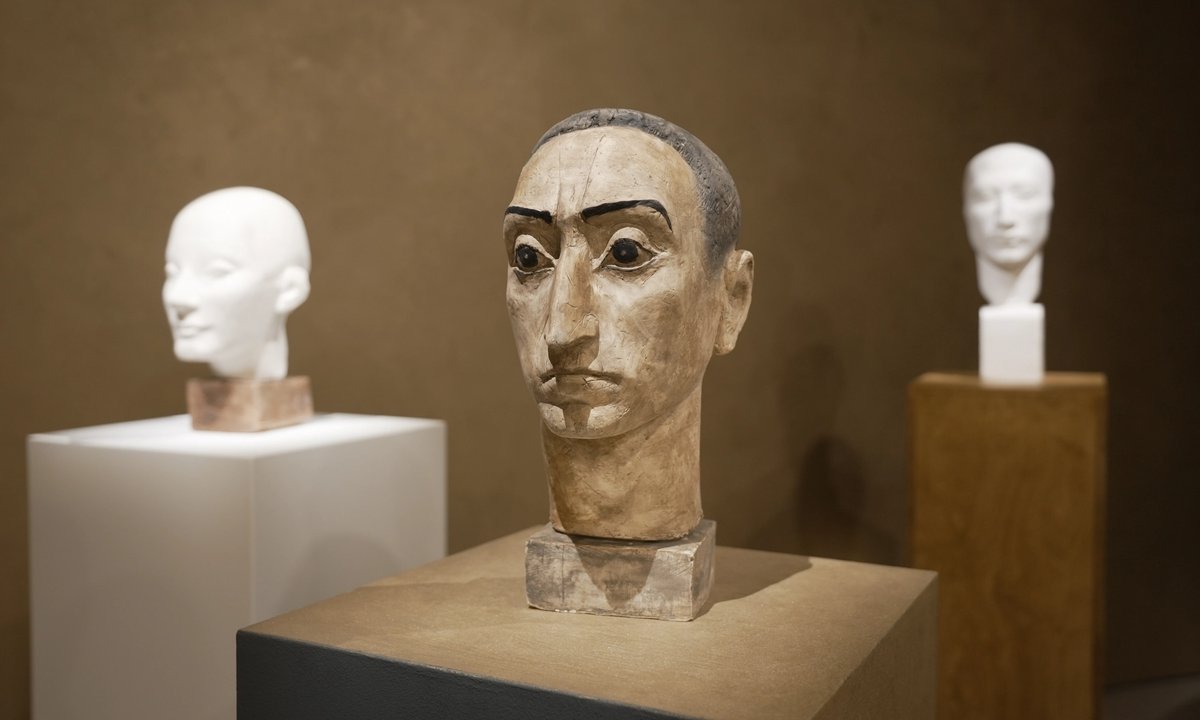
An exhibition at ATINATI’s Cultural Center in Tbilisi presents the work and legacy of Georgian sculptor and teacher Rusudan Gachechiladze, who died on 26 November. Born in 1937, she belonged to a generation that reshaped Georgian sculpture after the war. She trained at the Tbilisi Academy of Arts, later taught there, and developed sculptural portrait heads using simplified, universal forms that still preserved individual character. Many works are made of plaster, with some colored to resemble terracotta, stone, or bronze. The show also includes Modernist-inspired sketches created in the 2000s. The exhibition draws on the ATINATI collection, which has grown to over 3,000 works tracing Georgian art from Modernism to the present.
"Born in 1937, Gachechiladze was part of a generation that introduced important transformations into Georgian sculpture. She trained and then later taught at the Tbilisi Academy of Arts, but her practice went beyond the traditional framework of realistic representation. Paralleling the developments of European Modernism, her sculpted portrait heads utilise simplified and universal forms, while maintaining a deep sense of the individual character of her subjects."
"Much of the work in the show is in plaster, some of which have been coloured to give a sense of terracotta, stone or bronze. The exhibition also includes a series of sketches inspired by Modernist sculpture that Gachechiladze made in the 2000s, when she was in her 70s and 80s."
"The exhibition is the latest in a series showcasing key figures in Georgian art, using pieces from the ATINATI collection. The collection has grown to more than 3,000 works over the past five years, tracing the evolution of Georgian art from Modernism to the present. ATINATI is a non-profit charitable foundation dedicated to promoting Georgian culture and art, through exhibitions in the Cultural Center and through the online media platform, ATINATI.com."
"Rusudan Gachechiladze occupies a very important place in the development of post-war Georgian sculpture, particularly through her transformation of portrait sculpture in the 1960s and 1970s. Her work introduced a new plastic language that"
Read at The Art Newspaper - International art news and events
Unable to calculate read time
Collection
[
|
...
]