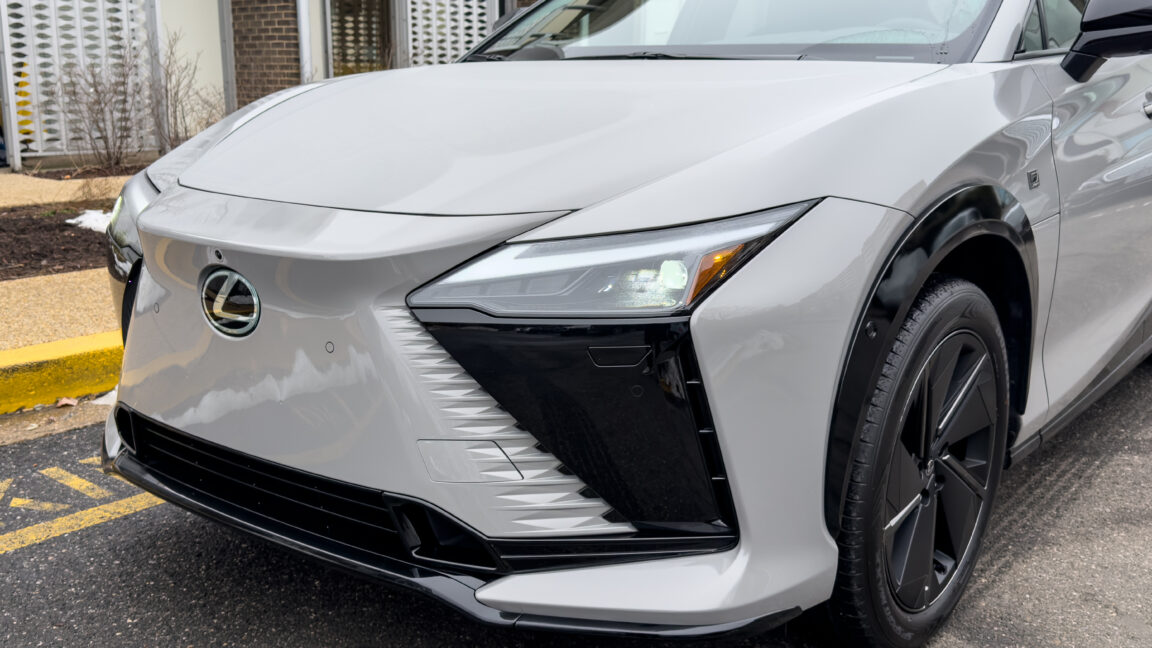
"Lexus knew there was room for improvement, too, so it reworked the RZ with new motors, a new battery, and NACS charging for North America, among other tweaks, for model year 2026. A front-wheel drive RZ 350e is now the range's entry point at $47,295, and there's also a $58,295 all-wheel drive RZ 550e F Sport that tops the range."
"There are new batteries for all MY2026 RZs, but the 550e benefits from a slightly larger capacity, at 77 kWh. Each axle features a permanent magnet synchronous motor, now with silicon carbide electronics, that delivers a combined 402 hp (300 kW). There's also some new body stiffening, plus added sound dampening."
"On those 20-inch wheels, the range is just 229 miles (369 km), and that's only in optimum ambient conditions. In chilly but not sub-freezing February weather, the RZ 550e averaged 2.5 miles/kWh, and with the battery at 50 percent state of charge, the car reported only 88 miles (142 km) of range."
Lexus redesigned its first battery electric vehicle, the RZ, for model year 2026 with significant improvements including new motors with silicon carbide electronics, a larger 77 kWh battery, and NACS charging capability. The all-wheel drive RZ 550e F Sport produces 402 hp and starts at $58,295. Despite these enhancements, the vehicle has notable limitations: range reaches only 229 miles under optimal conditions and drops to 88 miles in cold February weather at 50 percent charge. AC charging improved to 11 kW, and DC fast-charging achieves 10 to 80 percent in approximately 30 minutes. The reviewer initially disliked the original RZ but found unexpected appreciation for the redesigned model despite its shortcomings.
Read at Ars Technica
Unable to calculate read time
Collection
[
|
...
]