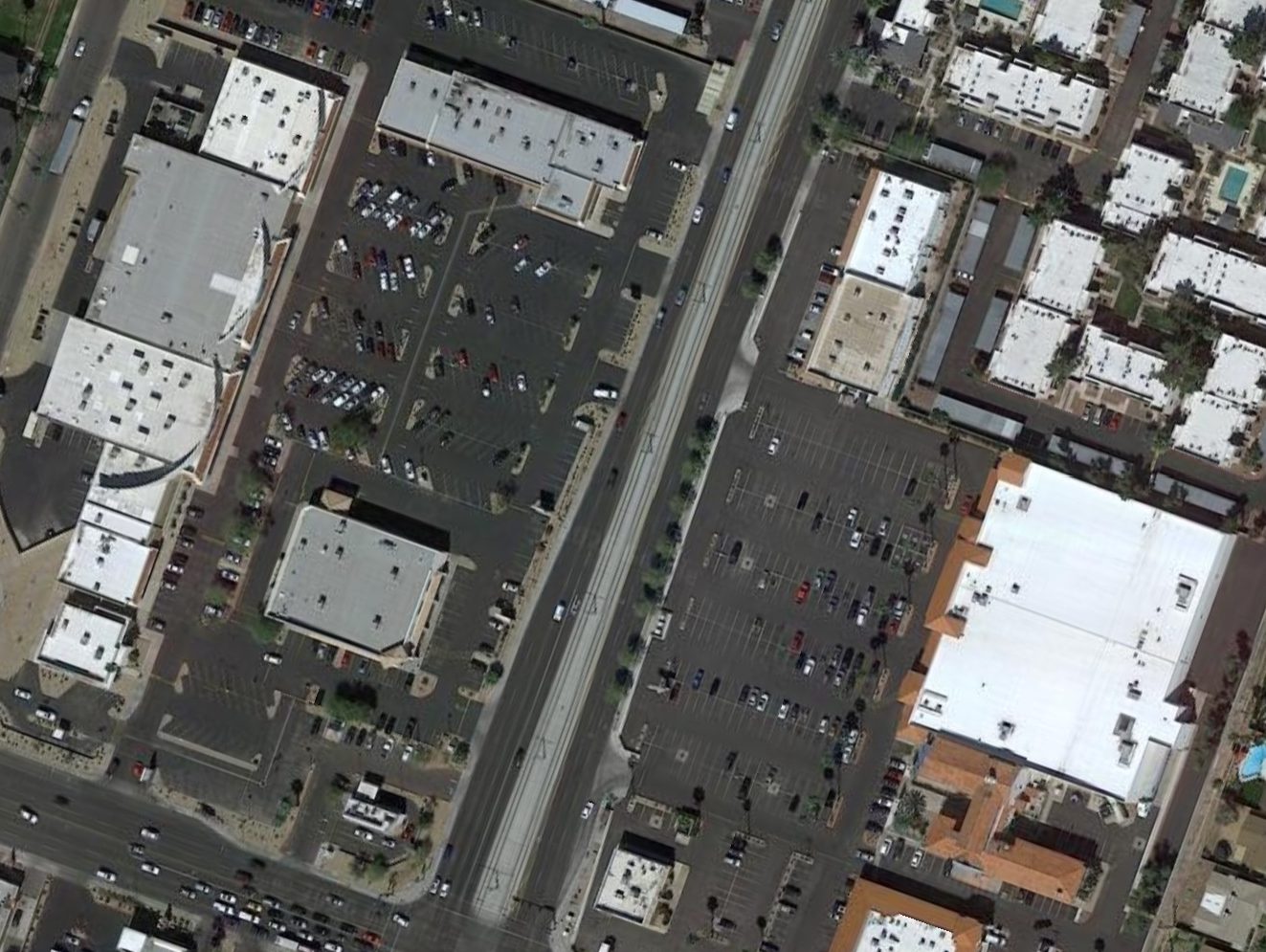
Phoenix contains 12.2 million parking spaces across residential, commercial, and on-street categories. The inventory estimates 4.3 parking spaces per registered vehicle and about three spaces per person, with roughly 10% of urbanized metro land devoted to storing cars. Since 1960, the city has added about 200,000 spaces per year. Asphalt absorbs about 95% of incoming solar radiation, reaching surface temperatures around 150–170°F, which can cause second-degree burns in under 30 seconds. Thermal imaging shows parking lots and roads glowing at 120–160°F even when air temperatures are near 106°F. Cars in these lots act as ovens, and rising hot air forms a barrier to cooling.
"Stand in a surface parking lot in Phoenix on a July afternoon and you are standing on one of the hottest surfaces a human body can approach without being burned. Phoenix has 12.2 million of these spaces. That figure comes from a peer-reviewed inventory published in 2019 by researchers at Arizona State University, among them Mikhail Chester, who led the study, and David King, an associate professor of urban planning and a student of the late Donald Shoup, whose work on parking economics reshaped the field. They counted off-street residential spaces, off-street commercial spaces, on-street spaces - all of it."
"The result: 4.3 parking spaces per registered vehicle. Roughly 3 spaces per person. Ten percent of all urbanized land in the metro devoted to storing cars. Since 1960, Phoenix has added roughly 200,000 new spaces per year. The asphalt beneath your feet absorbs approximately 95 percent of the solar radiation hitting it. Its surface temperature is somewhere between 150 and 170 degrees Fahrenheit - the upper range hot enough to cause a second-degree burn in under 30 seconds."
"NASA's thermal imaging of Phoenix on a June day in 2024, when the air temperature was 106, showed roads and parking lots glowing between 120 and 160 degrees across the metro. The cars sitting in those lots are ovens. The air rising off the pavement is a wall. The number is hard to feel from inside a car, which is where most people in Phoenix experience the city. The parking lot is invisible infrastructure - noticed only when it is full, which it rarely is, because the system was designed around the assumption of peak demand and routinely runs at a fraction of capacity."
"Most spaces sit empty most of the time. Their vacancy is not experienced as waste. It is experienced as availability, which is to say, as comfort, which is to say, as the whole point. But the lot does not stop ex"
Read at Streetsblog USA
Unable to calculate read time
Collection
[
|
...
]