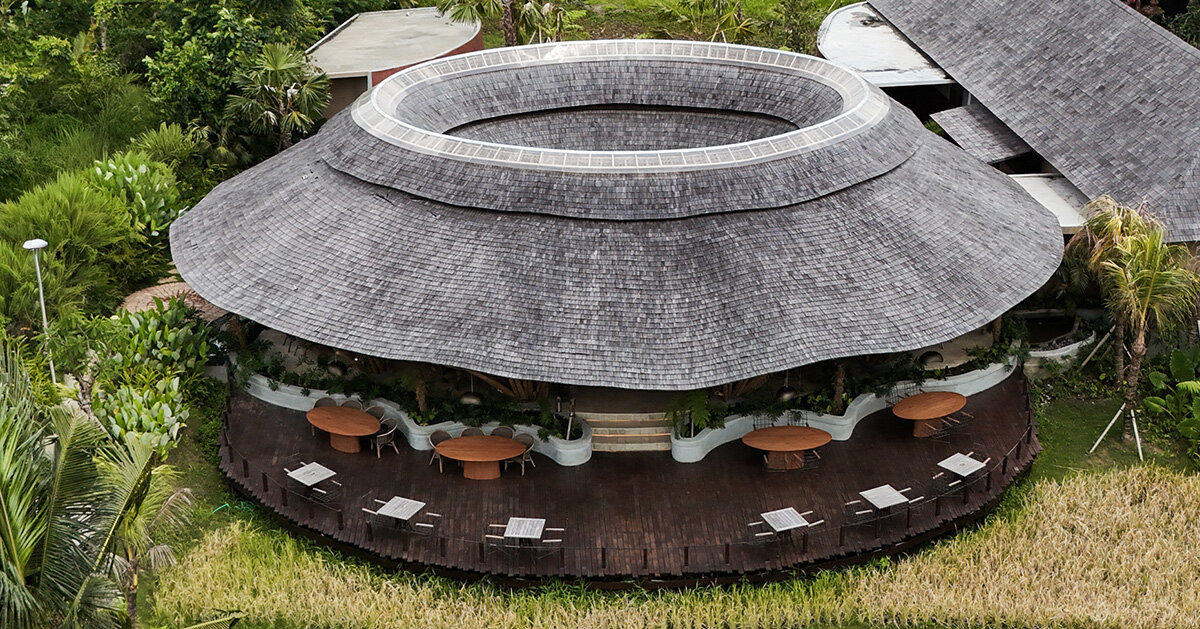
Juna Ubud Restaurant occupies an elevated site in Ubud, Bali, overlooking a river and rice fields. The building uses bamboo as the primary structural material, combining arches and an A-frame system to define the enclosure and support a visually light stepped roof. The roof channels rainwater toward a central point while a SolarTuff skylight on a steel frame provides a watertight opening. Ulin wood shingles cover the upper roof, crafted by local artisans. A circular plan creates an internal opening for light and ventilation, avoids a single apex, and arranges dining spaces to frame internal and outward views toward the river valley.
"Juna Ubud Restaurant is a bamboo-built dining space by Pablo Luna Studio, set along Jalan Arjuna in Ubud, Bali. Sitting on an elevated plot overlooking a river and rice fields to the west, the project uses a circular plan, vernacular construction knowledge, and passive environmental strategies to shape a restaurant that is as much about climate, structure, and craft as it is about food."
"The primary structure is made of bamboo, organized through a combination of arches and an A-frame system that defines the enclosure. This structural logic supports the stepped roof, which directs rainwater to a central point while remaining visually light. A skylight made from SolarTuff panels sits on a steel frame, finished to blend with the bamboo structure and provide a watertight surface. Above, the roof is clad in ulin wood shingles, crafted by local artisans."
"At the center of the project by Pablo Luna Studio is a circular layout that establishes a clear human scale within a built-up area. This geometry creates an internal opening through which light and air enter the structure, offering what the describe as a central relief. The decision to avoid a single roof apex is critical here. A converging roof would have required excessive height and risked enclosing the interior."
Read at designboom | architecture & design magazine
Unable to calculate read time
Collection
[
|
...
]