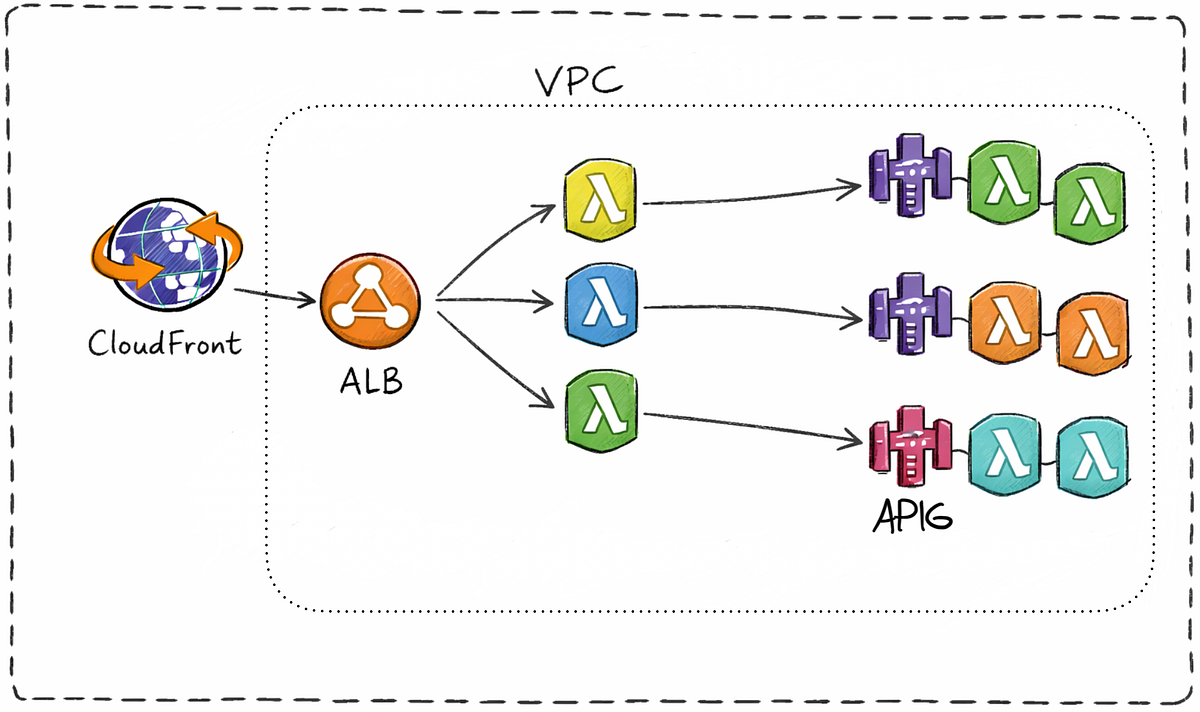
"Modern serverless platforms often need to support a mix of public-facing entry points - web applications and APIs - while keeping internal communication private and tightly controlled. Non-functional requirements around security, compliance, and operational isolation typically drive this architectural approach."
"Such platforms are increasingly built around multiple domain services, each representing a bounded context and owned by a small team. Independent deployments, limited blast radius, and clear ownership are usually explicit architectural goals that shape infrastructure decisions."
"Architectural choices at the edge - specifically around CloudFront, Application Load Balancers (ALB), and API Gateway - can either enable or severely constrain speed. Careful reuse of these components can support isolated, per-service deployments and on-demand environments without driving up cost or operational complexity."
Serverless platforms must balance multiple competing requirements: public-facing entry points with private internal communication, domain-driven architecture with independent deployments, and operational isolation with development velocity. Organizations increasingly adopt microservices patterns where each team owns bounded contexts with independent deployment capabilities and limited blast radius. However, these architectural goals often conflict with the need for rapid feature environment provisioning and quick iteration cycles. Edge infrastructure components—CloudFront, Application Load Balancers, and API Gateway—play critical roles in enabling or constraining this speed. Strategic reuse of these components can support isolated per-service deployments and on-demand environments while managing costs and operational complexity, though trade-offs emerge at certain scales.
#serverless-architecture #edge-infrastructure #microservices-deployment #infrastructure-trade-offs #development-velocity
Read at Medium
Unable to calculate read time
Collection
[
|
...
]