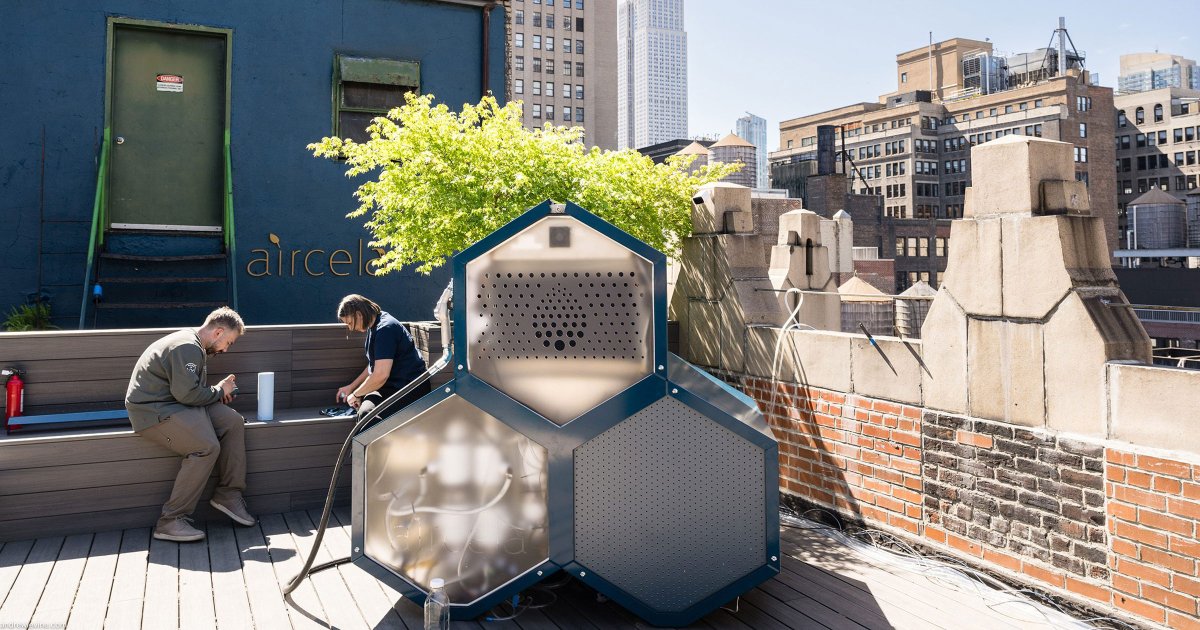
"A value proposition that could make the idea far more grounded: what if the captured carbon dioxide could be converted into a different form of energy, treating the atmosphere like a giant power storage system? Now, a New York City-based startup, called Aircela, has come up with an intriguing contraption that can trap carbon dioxide from regular air and turn it into usable gasoline."
"It's a clever, three-step process that is firmly rooted in science. First, the carbon dioxide is separated out from the air through a process known as direct air capture, roughly the same that climate change-fighting technology scientists are studying in their efforts to sequester greenhouse gas emissions, albeit on a much smaller scale. Through splitting water via electrolysis, the machine simultaneously produces hydrogen, which is then mixed with the captured carbon dioxide to synthesize methanol."
"For one, Aircelo's machine can only produce a single gallon a day, which means you won't be able to rely on it to drive more than a handful of miles. And as Aircelo admitted to The Autopian last year, it's also a considerably energy-intensive process, requiring about twice as much energy going in as is trapped in the gasoline being produced. That means it's also extremely inefficient, with Aircelo still struggling"
A refrigerator-sized machine captures carbon dioxide from ambient air via direct air capture and splits water by electrolysis to produce hydrogen. The captured CO2 and generated hydrogen are combined to synthesize methanol, which is converted into motor-grade gasoline using an established process. The resulting gasoline is intended as a fossil-free, drop-in fuel compatible with existing engines without modifications. The device currently produces about one gallon of gasoline per day, providing only a few miles of range. The overall process is energy-intensive and requires roughly twice the energy input compared with the energy contained in the produced gasoline, yielding low system efficiency.
Read at Futurism
Unable to calculate read time
Collection
[
|
...
]