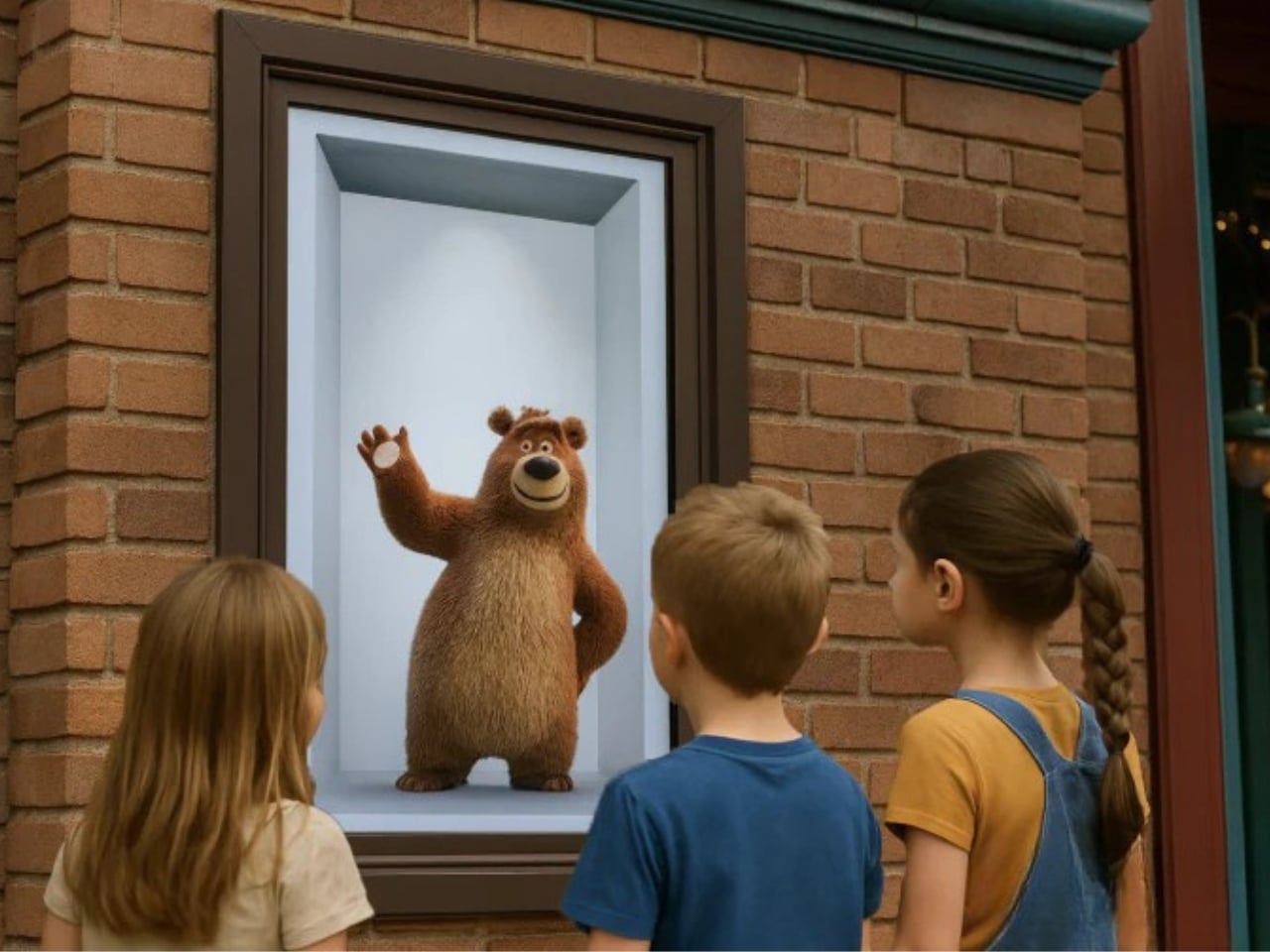
"The Hololuminescent™ Display (HLD) is a revolutionary razor-thin holographic display that transforms standard 2D video content into three-dimensional, spatial experiences. Basically, it can display virtual space from your ordinary videos to make it seem like the people, products, and characters in them are floating in mid-air on the display screen. So those scenes from sci-fi movies with hologram videos in public spaces won't be sci-fi anymore in the very near future."
"The HLD has a built-in holographic layer inside the LCD/OLED panels that creates what they call a "holographic volume." There's a 16″ model that is perfect for your desktop or counter, and there's an 86″ model that can be used in retail stores, public installations, and as signage. It has an ultra-slim design, so you can display it anywhere you could put a regular 2D screen. It uses patented technology (with some patents still pending) for both the hardware and software, with worldwide protection."
"Unlike some of the VR/AR devices out there, this one doesn't need any glasses or additional devices. Viewers can experience these 3D holograms with just their naked eyes, making it completely accessible and barrier-free. What's more, it can transform standard 2D videos into holographic displays, so you don't need to pay for expensive 3D modeling or complex production pipelines. Of course, there may probably still be some expense involved in optimizing these videos, but it will likely not be as expensive as the usual methods."
The Hololuminescent Display (HLD) is a razor-thin holographic panel that converts standard 2D video into three-dimensional spatial experiences. The HLD contains a built-in holographic layer within LCD/OLED panels that generates a holographic volume. Two models are offered: a 16" desktop/counter unit and an 86" model for retail, public installations, and signage. The ultra-slim design supports placement wherever 2D screens are used. No glasses or additional devices are required; viewers perceive 3D holograms with the naked eye. The system converts existing 2D videos into holographic displays, lowering the need for costly 3D production, though video optimization may incur some expense. Hardware and software are protected by patents.
Read at Yanko Design - Modern Industrial Design News
Unable to calculate read time
Collection
[
|
...
]