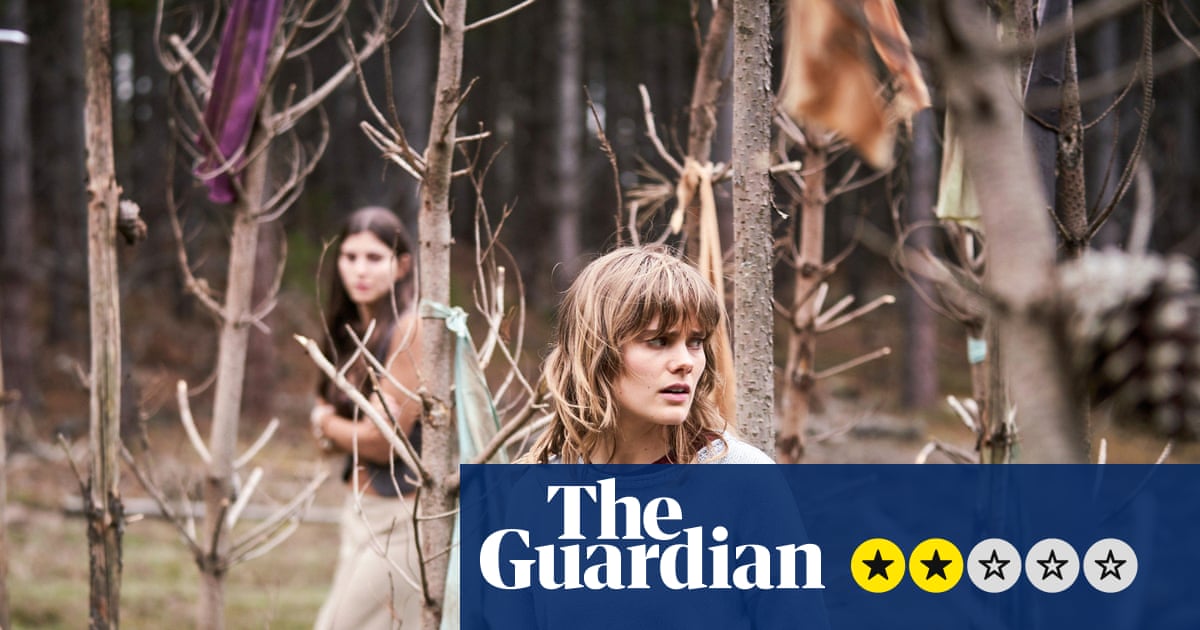
Elise, an artist who fled a fundamentalist Latter-day Saints branch ten years earlier, avoids her boyfriend and behaves erratically, digging holes and damaging the living room at night. She paints a grimy cellar door and undergoes regression therapy using an ayahuasca variant with close pals after returning to Mormon country in Haventon. The therapy proves ill-advised as an actual cellar door is uncovered and participants begin throwing up. Flashbacks reveal suppressed experiences, including Elise’s closeness to the bishop’s daughter Clara, suggesting bisexuality rather than possession. The horror outcomes feel middling, lacking a decisive religious-conversion payoff and avoiding campy release. Visuals remain wintry and low-lit, with occasional dreamlike imagery, but the direction leans toward conventional tactics and heavy-handed Mormonphobia.
"Ten years after fleeing a fundamentalist branch of the Latter-day Saints, snub-nosed artist heroine Elise (Elizabeth Cullen) has started shunning the attentions of boyfriend Adam (John Kim), instead obsessively digging holes in the couple's back garden and trashing the living room in the middle of the night. Could it have something to do with the grimy cellar door she feels compelled to paint, or the traumatic baptism we witness in a pre-title sequence? What are the chances?"
"For somewhere between half and two-thirds of its running time, we're watching a diagnostic case study: Elise and close pals return to Mormon country more specifically, the in-no-way ironically named hamlet of Haventon to undergo a regression therapy involving an ayahuasca variant; this will strike anyone as ill-advised even before an actual cellar door is uncovered outside and everybody starts throwing up. (Cue the especially dreadful line: She must have torn internally.)"
"Thereafter, flashbacks reveal what's been suppressed or concealed: the younger Elise's growing closeness to the bishop's daughter Clara (Luca Sardelis) would seem to indicate our girl isn't possessed, merely bisexual. The results prove middling at best, not on any level dealing the knockout blow that religious conversion practice deserves; nor is it ever the campy scream the set-up might have licensed."
"Cinematographer Michael Tessari gives matters a wintry, low-lit, persuasively un-Australian look, and gathers the odd suggestive image, like a dream sequence scattering of petals. More of that would have done Diabolic a world of good, but co-writer and director Daniel J Phillips heads the other way, cranking up the soundtrack's parping and underlying Mormonphobia with supporting players going heavy"
#indie-horror #mormon-country #regression-therapy #religious-conversion #australian-shot-us-set-film
Read at www.theguardian.com
Unable to calculate read time
Collection
[
|
...
]