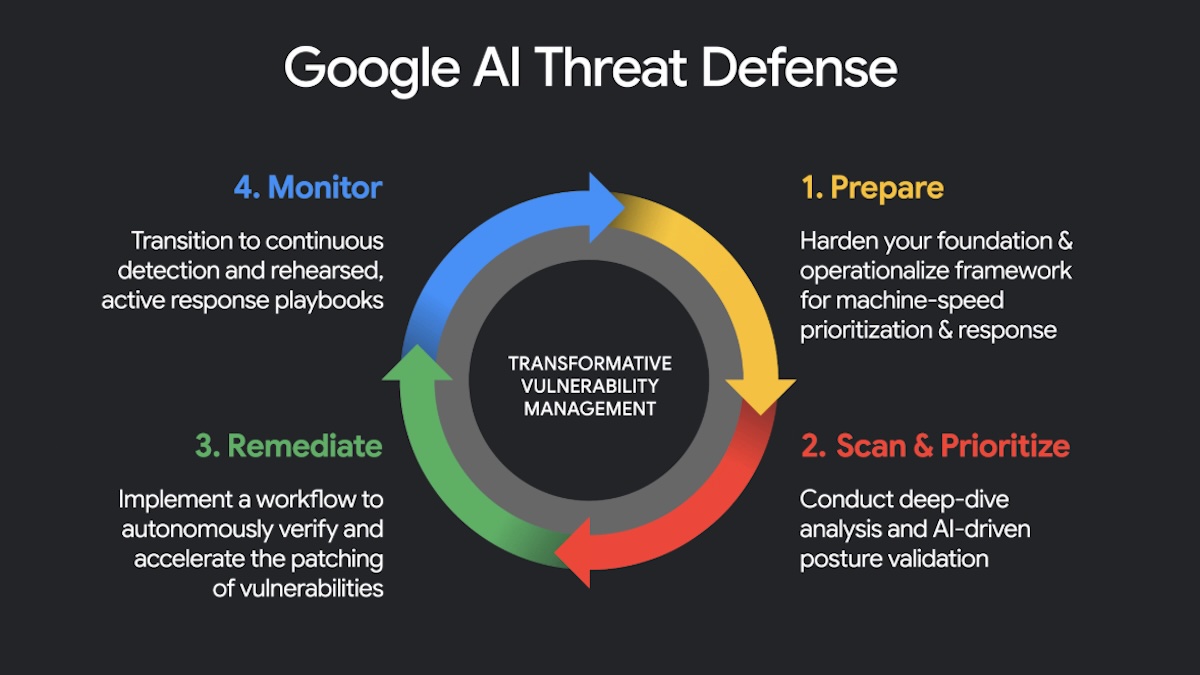
Google Cloud announced an always-on autonomous cybersecurity platform, Google AI Threat Defense, aimed at protecting enterprises from AI-powered cyberattacks. The platform uses AI to identify machine-powered threats faster and stop them before harm occurs. It continuously prioritizes critical real-world risks and helps organizations predict attack paths and proactively deploy remediation. The solution combines Mandiant incident response experience, Wiz cloud security capabilities, and Gemini reasoning and code remediation powered by Gemini and CodeMender. It uses a four-step framework: map the environment for asset visibility, perform deep-dive assessments and AI-driven posture validation, implement workflows for fast autonomous vulnerability remediation, and enable machine-speed detection and response. It begins with exposure reduction by making sensitive assets unreachable from the internet and scanning for exposed APIs, applications, configurations, identities, and permissions.
"Google Cloud this week announced an always-on autonomous platform designed to protect enterprises from the rising wave of AI-powered cyberattacks. The new Google AI Threat Defense cybersecurity solution leverages AI to identify machine-powered threats faster and stop them before they can do harm. According to Google, the platform continuously prioritizes critical real-world risks and can help organizations implement defenses that predict attack paths and proactively deploy remediation."
"Google AI Threat Defense combines Mandiant's frontline and incident response experience with Wiz's cloud security platform (recently acquired by Google) and Gemini's reasoning and code remediation capabilities powered by Gemini and CodeMender. "By connecting real-world exposure directly to autonomously creating and prioritizing patching, AI Threat Defense helps organizations actively predict attack paths, prioritize the most significant threats, and deploy verified fixes faster than adversaries can exploit them," Google says."
"To match the speed of attackers and help organizations surface weaknesses in their software, AI Threat Defense uses the same four-step framework that the internet giant is relying on to stop threats and transform vulnerability management. It involves mapping the environment for asset visibility, conducting deep-dive assessments and AI-driven posture validation, implementing workflows for fast, autonomous vulnerability remediation, and implementing machine-speed detection and response."
"The first step, Google says, requires exposure reduction by making sensitive assets unreachable from the internet. Each organization also needs to understand its time to remediation and its ability to prioritize risks, and needs to scan environments using AI to identify exposed APIs, applications, configurations, identities, and permissions. "Traditional attack surface management helps identify what is exposed, but organizat"
#ai-powered-cybersecurity #autonomous-vulnerability-remediation #attack-surface-management #cloud-security #threat-detection-and-response
Read at SecurityWeek
Unable to calculate read time
Collection
[
|
...
]