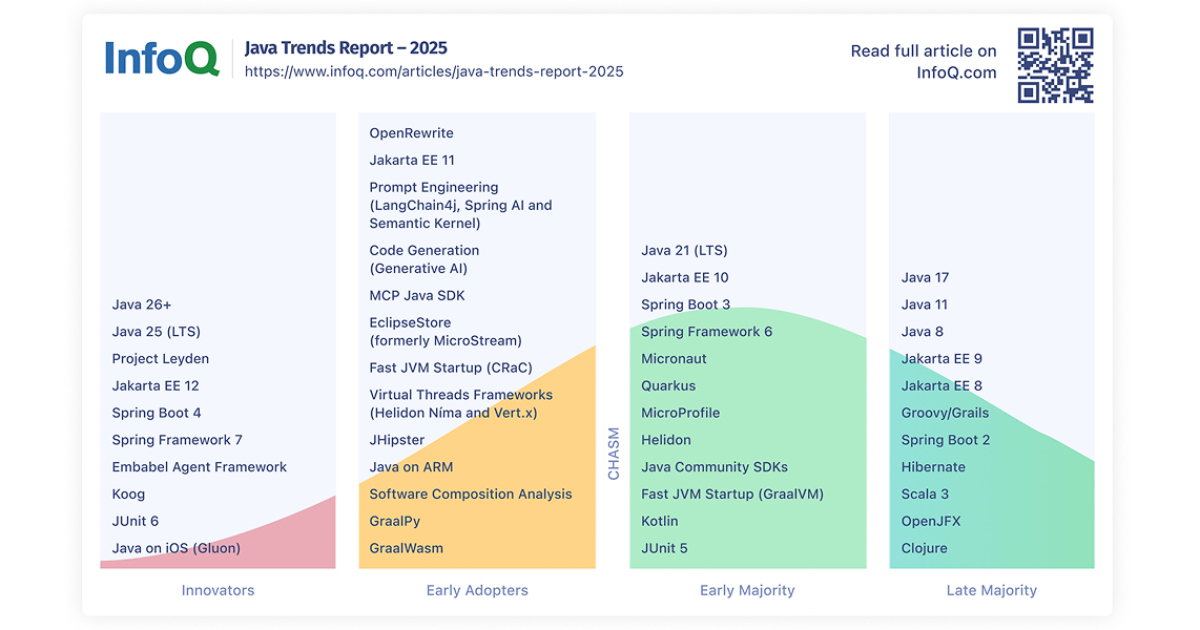
"This report summarizes the InfoQ Java editorial team's current perspective on the adoption of technology and emerging trends within the Java space. We focus on Java, the language, as well as related languages such as Kotlin and Scala, the Java Virtual Machine (JVM), and Java-based frameworks and utilities. We discuss trends in core Java, including the adoption of new Java versions, as well as the evolution of frameworks such as the Spring Framework, Jakarta EE, Quarkus, Micronaut, Helidon, and MicroProfile."
"This report has two main goals: To assist technical leaders in making mid- to long-term technology investment decisions. To help individual developers choose where to invest their valuable time and resources for learning and skill development. This is our seventh published Java trends report. However, this topic has received ample news coverage as we have internally tracked Java and JVM trends since 2006."
AI frameworks such as Embabel, Koog, Spring AI, and LangChain4j drive AI-native and AI-assisted development on the JVM. Java 25 provides a modern LTS baseline that improves readability, concurrency, and performance while frameworks standardize on Java 17+. Organizations prioritize updating legacy applications and older Java versions, with OpenRewrite emerging as the dominant automation tool for modernization. Jakarta EE 11 stabilizes and Jakarta EE 12 work, notably Jakarta Query, advances the platform. Community engagement grows and enterprises increasingly explore hybrid, regional, and on-premises deployment strategies. The ecosystem includes Java, Kotlin, Scala, JVMs, and frameworks like Spring, Quarkus, Micronaut, Helidon, and MicroProfile.
Read at InfoQ
Unable to calculate read time
Collection
[
|
...
]