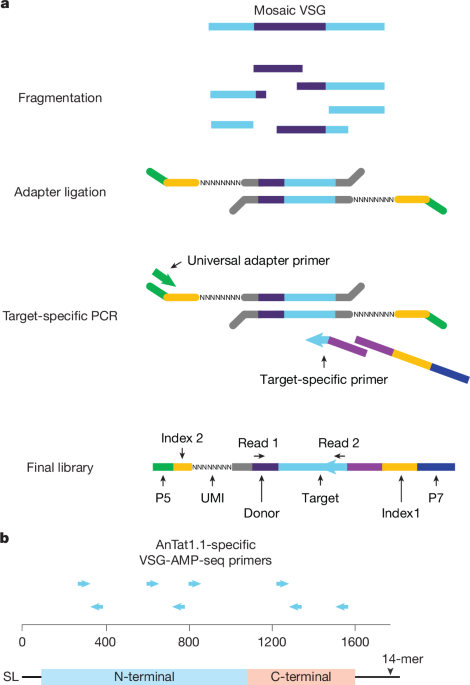
Trypanosoma brucei employs antigenic variation to evade host immunity by periodically switching its variant surface glycoprotein (VSG). This unicellular parasite expresses a single VSG from one of about 15 active bloodstream expression sites while the rest remain silenced. Although the parasite has thousands of VSGs, only about 20% are full-length genes capable of functional expression. The remaining 80% are pseudogenes or fragments, limiting the potential for immune evasion through in situ switching alone.
"The African trypanosome Trypanosoma brucei uses an especially sophisticated system of antigenic variation, periodically 'switching' expression of a surface coat consisting of 10 7 copies of a single, immunogenic protein known as the variant surface glycoprotein (VSG)."
"During an infection, each T. brucei parasite expresses a single VSG at a time from one of about 15 telomeric bloodstream expression sites (BESs), while the remaining VSG-encoding genes are stored in other expression sites, subtelomeric arrays and minichromosomes."
"Although gene conversion-based switching allows for the activation of VSGs outside of a BES, analysis of the T. brucei genome has shown that only around 20% of the VSGs in the parasite genome are full-length genes encoding a functional VSG protein."
#trypanosoma-brucei #antigenic-variation #immune-evasion #variant-surface-glycoprotein #pathogen-survival
Read at Nature
Unable to calculate read time
Collection
[
|
...
]