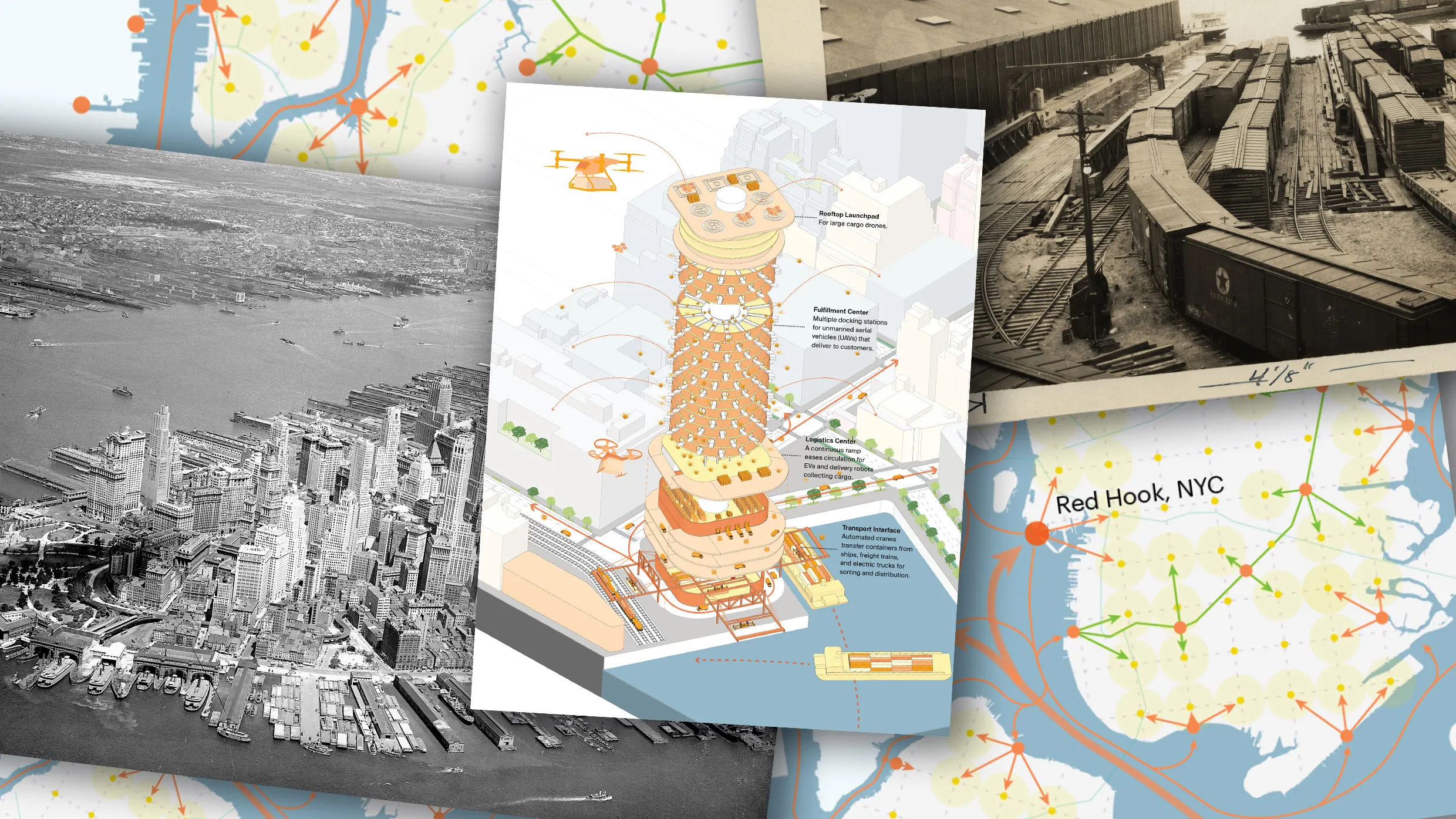
"The answer, which is outlined in the firm's latest book, Connective Urbanism - New York, features towering distribution hubs, drones, and a hyper-connected logistics network that encompasses the city's rails and waterways. KPF presents its solution as a provocative speculation designed to start a dialogue about the city's delivery problem, but it is more grounded in reality than it seems. "We didn't want to have speculations that were just dreams," says Bruce Fisher, head of KPF Urban, and a co-author of the book."
"In a place as dense as New York City-both in terms of population and building stock-good logistics are everything. As Fisher writes in the book: "A city's economic potential is tied to its logistic efficiency." Highways centralized transport. Can it be diversified? There once was a time when most goods arrived in New York City via train and freight ships. Before the Holland Tunnel opened in 1927, nearly all domestic freight destined for New Jersey, then crossed the river on cargo ferries or "carfloats" outfitted with rail tracks."
New Yorkers receive about 2.3 million packages daily, and nearly 90 percent are delivered by trucks that increase congestion and air pollution. Global architecture firm KPF asks what New York would look like if designed for efficient delivery and envisions towering distribution hubs, drones, and a hyper-connected logistics network using rails and waterways. The city's freight movement historically relied on trains and ships and shifted toward trucks after the Interstate Highway System and containerization moved distribution to New Jersey. KPF advocates diversifying transport modes by leveraging existing freight rail lines, the coastline, and maritime capacity to reduce truck dependency.
Read at Fast Company
Unable to calculate read time
Collection
[
|
...
]