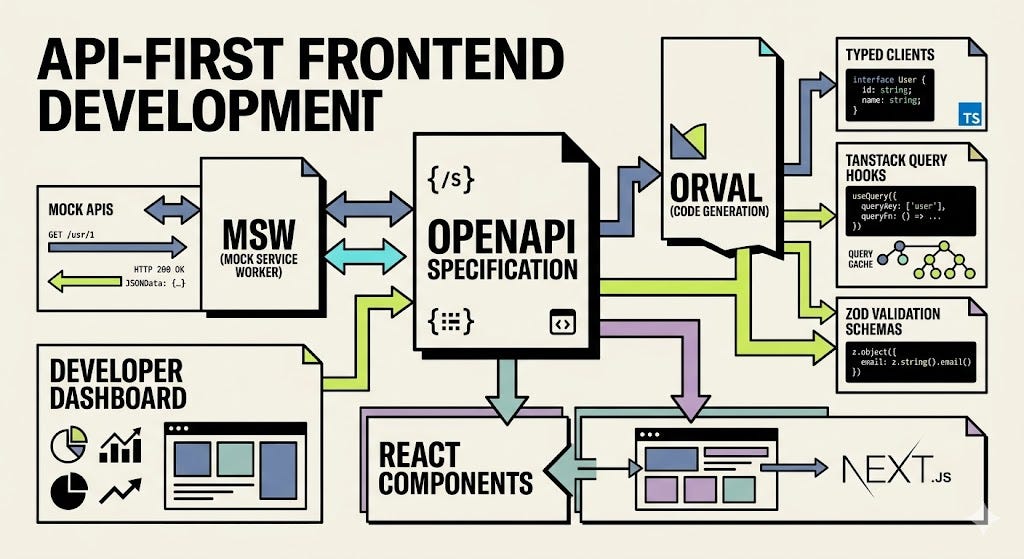
Frontend development often repeats a cycle where API changes break generated request functions, response types, React hooks, loading states, mutation handlers, mocks, and validation logic. Stale interfaces cause UI forms to fail, TypeScript to be misled, and QA to open many tickets. This worsens as applications grow. OpenAPI specifications can be more than static documentation by becoming the single source of truth for frontend integration. An API-first workflow makes the contract the first deliverable, enabling frontend work before backend implementation without fake mocks or guessed interfaces. Automated generation can produce TypeScript models, API clients, and React hooks from the contract.
"Frontend development has a repetitive problem that almost every team eventually rediscovers. You receive an API endpoint. You write: request functions response types React hooks loading states mutation handlers mocks validation logic Then the backend changes one field. Now: generated screenshots fail UI forms break stale interfaces lie to TypeScript QA opens twelve tickets The larger the application becomes, the worse this cycle gets."
"The irony is that modern teams already possess something capable of solving a large part of this problem: the API contract. That contract usually exists as an OpenAPI specification. Unfortunately, many teams still treat OpenAPI as documentation. Useful documentation. Ignored documentation. Static documentation. But OpenAPI can be much more than a Swagger page living somewhere inside infrastructure documentation."
"In a modern TypeScript workflow, OpenAPI can become the single source of truth powering your entire frontend integration layer. Many frontend teams still work in a backend-last model. The workflow usually looks like this: UI design begins. Backend implementation begins. Frontend waits. Backend finishes endpoints. Frontend starts integration. Everybody discovers mismatched assumptions."
"API-First changes the order. Instead of backend implementation being the first deliverable, the API contract becomes the first deliverable. That means frontend developers can begin work before the backend exists. Not with fake hand-written mocks. Not with guessed interfaces. With a real contract. An OpenAPI specification can drive far more than Swagger UI. A modern workflow can automatically generate: TypeScript models API clients React hooks qu"
Read at reactdevelopment.substack.com
Unable to calculate read time
Collection
[
|
...
]