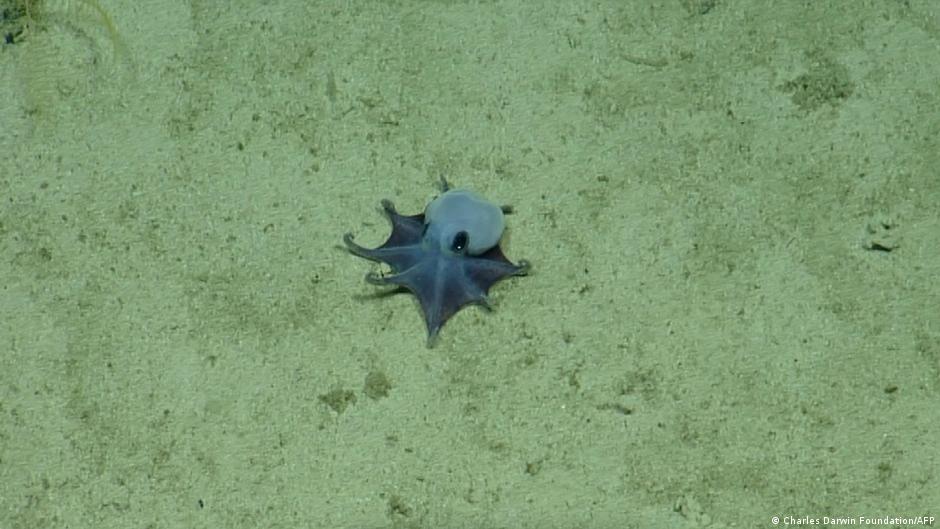
A new octopus species named Microeledone galapagensis was found on the ocean floor of Ecuador’s Galapagos Islands. The animal is tiny and blue, about the size of a golf ball, and was observed roughly 5,800 feet below the water’s surface. Scientists aboard the E/V Nautilus used a remotely operated camera to notice the octopus during deep-sea exploration in 2015. Researchers later collected the specimen and saw additional individuals that looked similar. After returning the octopus to the Charles Darwin Research Station, researchers were uncertain of its species and arranged for lead researcher Janet Voight to examine it. The specimen was preserved in alcohol and formalin and sent to Chicago for study at the Field Museum.
"“Right away, I knew it was something really special. I'd never seen anything like it,” said Janet Voight, the lead author of the study. In 2015, scientists aboard the E/V Nautilus submersible were studying the ocean floor using the sub's remotely operated camera when they noticed the octopus, about 5,800 feet (1768 meters) below the water's surface."
"“He's tiny!” “It's blue!” That's how researchers described the octopus when they first saw the animal, according to the study. The crew aboard the submersible then collected the octopus and noted they saw two others that looked like it over the course of their deep-sea mission."
"But when the octopus was brought back to the Charles Darwin Research Station in Galapagos, researchers were not sure what species it belonged to. They then contacted Janet Voight and went out of their way to make sure she had the specimen. Little octopus posed challenges for scientific research The octopus was little and one of a kind, which meant that researchers had to take specific measures to make sure they could study it."
"The octopus' body was preserved in alcohol and formalin and then sent from the Galapagos Islands to Chicago for Voight to examine the animal at the Field Museum, which is one of the world's largest natural history museums."
Read at www.dw.com
Unable to calculate read time
Collection
[
|
...
]