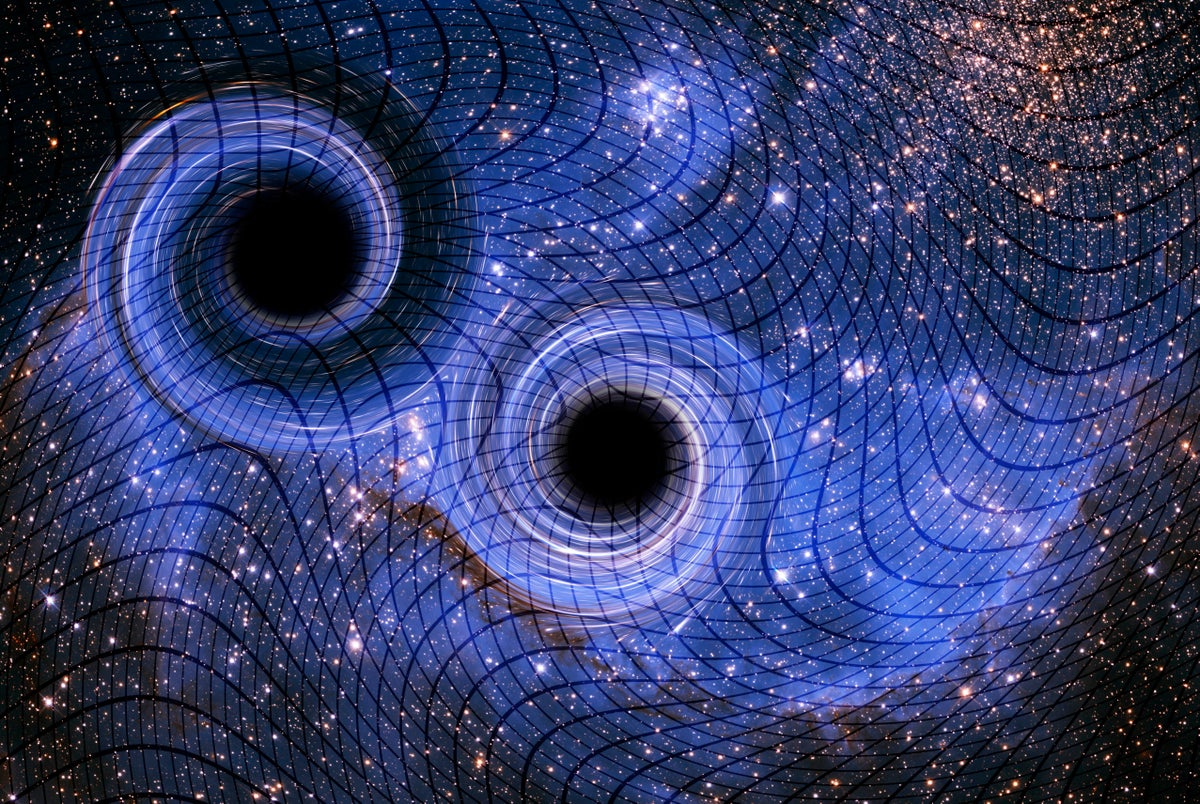
LIGO first detected gravitational waves more than a decade ago when two black holes merged about 1.3 billion light-years away, producing a spacetime ripple strong enough to reach Earth. Researchers have since improved detector sensitivity to capture more fleeting signals. Confirmed or high-quality candidate events are added to a catalog maintained by the LIGO-Virgo-KAGRA collaboration, which operates four detectors: two LIGO sites in the United States, Virgo in Italy, and KAGRA in Japan. The newest catalog entries report 161 events detected between April 2024 and January 2025. Detector sensitivity now enables three or four gravitational-wave signals every week, shifting research from initial discoveries toward precision gravitational astronomy.
"About 1.3 billion light-years away, two massive black holes had merged, and the resulting shockwavea gravitational wavewas strong enough for LIGO to detect the moment it washed over Earth. Since then gravitational-wave researchers have focused on fine-tuning their instruments to detect more of these fleeting ripples."
"Each confirmed or high-quality candidate event is added to a running tally in a catalog maintained by the LIGO-Virgo-KAGRA (LVK) Collaboration, a network of four gravitational-wave detectors: the two LIGO stations in the U.S., the Virgo station in Italy and the Kamioka Gravitational Wave Detector (KAGRA) in Japan."
"The newest entries on the collaboration's lista record-breaking 161 events spotted between April 2024 and January 2025have researchers excited for a new era of discovery, an age of gravitational astronomy. The extraordinary sensitivity of our detectors now allows us to capture three or four gravitational wave signals every week, said Ed Porter, a researcher at the AstroParticle and Cosmology Laboratory, overseen by the French National Center for Scientific Research (CNRS) and Paris City University, in a statement."
"This ever-growing wealth of data, which an entire community of scientists and astronomers is working to analyze and study, has taken us from the era of initial discoveries into that of precision gravitational astronomy. These recent weekly signals form about 75 percent of the total number of confirmed gravitational-w"
Read at www.scientificamerican.com
Unable to calculate read time
Collection
[
|
...
]