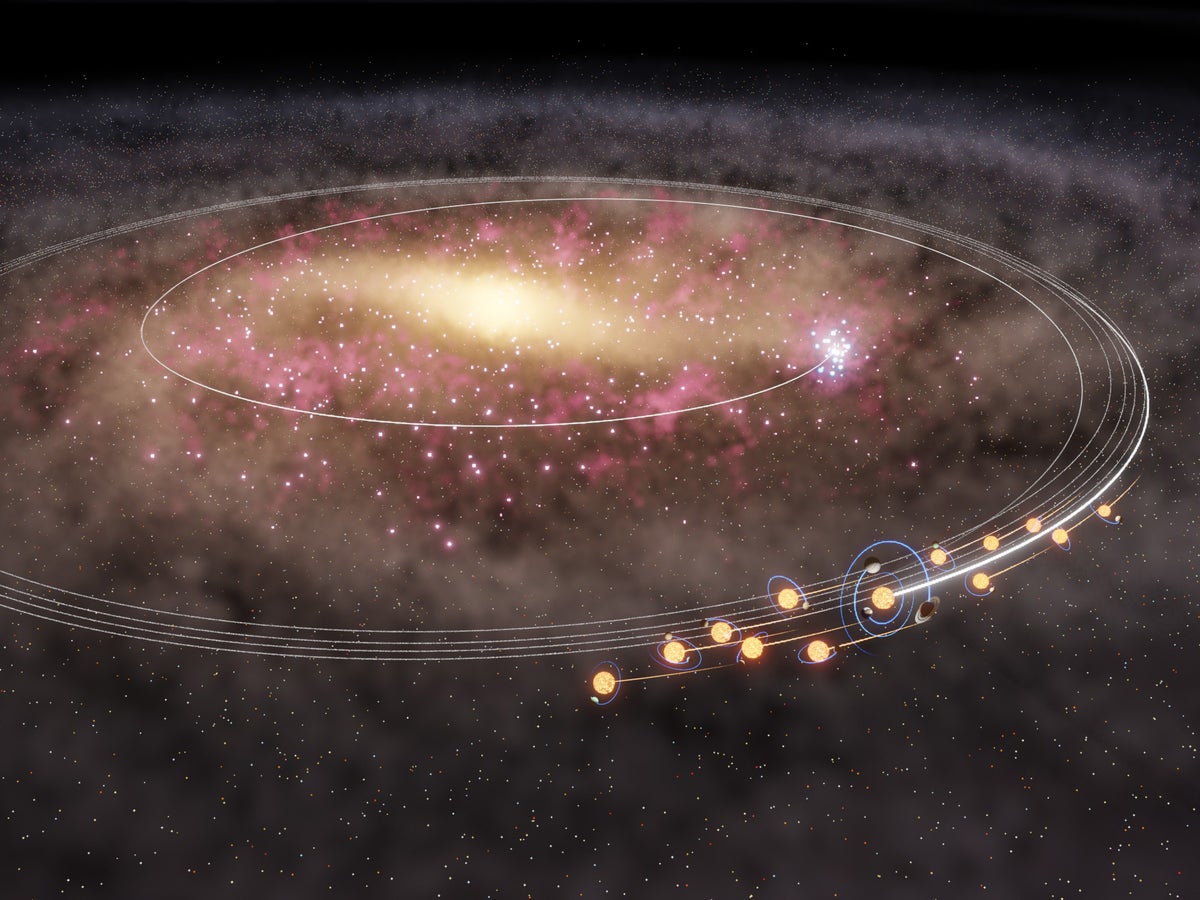
"The telltale sign of the sun's galactic journey is its chemical composition, says Tokyo Metropolitan University astronomer Daisuke Taniguchi, a co-author on both of the studies. Astronomers know that the sun's birthplace lies closer to the galactic core than its current position, Taniguchi explains. The Milky Way's dense inner regions formed stars faster and accumulated heavy metals far quicker than the outer edges—and a star with the sun's age and chemical components would not have been able to form at its present location."
"Observations of the Milky Way have revealed an enormous rotating barlike structure made of gas, dust and millions of stars slicing through our galactic center. This bar creates a distinct gravitational phenomenon known as the corotation barrier that prevents inner galaxy stars from migrating to the outskirts. Computer simulations suggest that only about 1 percent of stars born at the sun's presumed original location could successfully breach this barrier to reach our current neighborhood within a 4.6-billion-year time frame."
"And yet Taniguchi and his colleagues discovered that thousands of solar twin stars with a mass and a metal makeup similar to those of the sun managed to do so. On supporting science journalism If you're enjoying this article, consider supporting our award-winning journalism by subscribing. By purchasing a subscription you are helping to ensure the future of impactful stories about the discoveries and ideas shaping our world today."
The sun formed 4.6 billion years ago near the Milky Way's galactic center and migrated approximately 10,000 light-years outward to its current location in the galactic suburbs. Chemical composition analysis reveals the sun could not have formed at its present position, confirming its inner-galaxy origin. A rotating bar structure at the galactic center creates a corotation barrier that theoretically prevents inner stars from reaching the outer regions, with simulations suggesting only 1 percent of stars could successfully cross it. However, recent studies published in Astronomy and Astrophysics discovered thousands of solar twin stars with similar mass and metal composition managed to breach this barrier. Researchers used the European Space Agency's Gaia satellite to identify and catalog these stellar migrants.
#solar-migration #galactic-structure #stellar-chemistry #corotation-barrier #gaia-satellite-observations
Read at www.scientificamerican.com
Unable to calculate read time
Collection
[
|
...
]