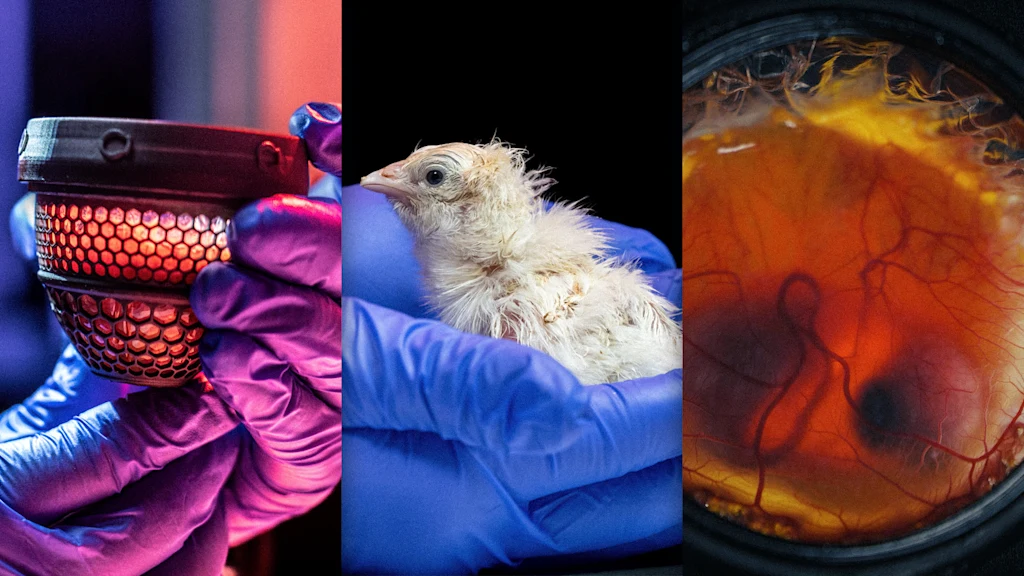
"Colossal designed a new system that functions essentially like a natural egg. One of the company's goals: to use it to bring back the South Island giant moa, a bird that went extinct in the 15 th century. But the technology could also be used to help breed currently endangered birds. It's not the first time that scientists tried to raise birds outside a natural shell. But previous systems, first developed in the 1980s, required a flow of oxygen and other interventions for the embryo to survive. (The oxygen also sometimes damages the birds' DNA.)"
"The new shell can sit inside an ordinary incubator. "We want to make sure that it is as close to an existing egg as possible," says Ben Lamm, Colossal's CEO. R&D took nearly two years. The new design uses a rigid titanium lattice, shaped like a partial egg, lined with a permeable membrane that can hold an embryo. The shell was initially "more egg-like," Lamm says. "But then we thought if we're going to be reimagining the egg, how do we reengineer it in a way that we get the most flexibility out of it?""
"Leaving the top open means that it can be attached to a microscope, for example, and easily monitored as the embryo grows. To test the system, the team carefully moved chicken embryos from regular chicken eggs to the new shell. When the chick is ready to hatch, it can pop through a thin membrane at the top; staff also monitor them to help them get out. Every chick that made it to term is now a healthy chicken, Lamm says."
"To raise a giant moa, the company would need to build a much larger version-the bird was as tall as 12 feet, with eggs as much as 80 times larger than a chicken egg. The company's controversial process to bring back extinct species involves sequencing surviving fr"
Chickens hatched from 3D-printed artificial eggs produced in a Dallas lab. The system is designed to function like a natural egg and can be placed inside an ordinary incubator. Earlier approaches required continuous oxygen flow and other interventions, which could damage DNA. The new design uses a rigid titanium lattice shaped like a partial egg and lined with a permeable membrane that holds an embryo. The top is left open to allow attachment to monitoring equipment such as a microscope. Chicken embryos were transferred into the new shells, and chicks were helped to hatch through a thin membrane. All embryos that reached term became healthy chickens. Larger versions could support breeding a South Island giant moa or endangered birds.
#3d-printed-biology #artificial-egg-incubation #de-extinction #avian-embryo-development #conservation-breeding
Read at Fast Company
Unable to calculate read time
Collection
[
|
...
]