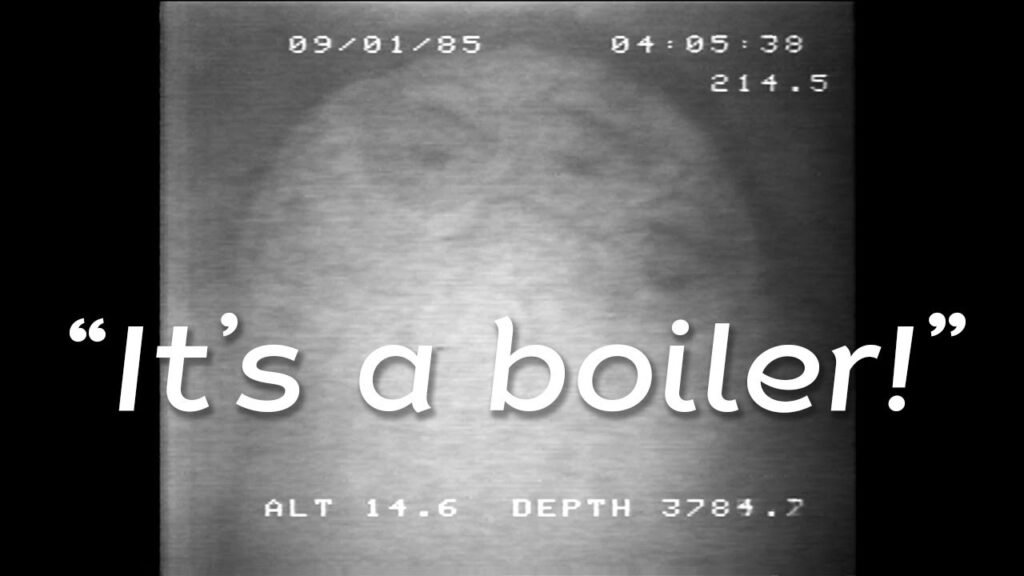
"Somebody should get Bob," says one of the crew as soon as it becomes clear, even on their low-resolution black-and-white monitor, that they're looking at man-made objects on the sea floor. And well they should have: the Bob in question is oceanographer and Argo inventor Robert Ballard, who'd been actively thinking about how to find the Titanic since at least the early nineteen-seventies and boarded Woods Hole Oceanographic Institute's R/V Knorr with intent to find it."
"In fact, the precise location of the shipwreck went unknown for more than 73 years, between the day of the disaster, April 15th, 1912, and that of the discovery, September 1, 1985. In the video above, you can watch the very moment debris from the Titanic first came into the view of Argo, the unmanned under-sea camera used by the researchers seeking it out."
"In truth, the voyage was financed by the U.S. Navy, which had much less interest in finding the wreck of the Titanic than those of the USS Scorpion and Thresher, two nuclear submarines lost in the sixties. If Ballard could look for them, so the deal went, he could use the expedition's spare time and resources on his life's mission."
The Titanic wreck remained widely known but its precise location was unknown for more than 73 years, from the April 15, 1912 disaster until September 1, 1985. An unmanned undersea camera system named Argo captured the first clear view of Titanic debris on the seafloor. Crew members recognized that the images showed man-made objects and immediately called for Robert Ballard, the oceanographer and inventor of Argo. Ballard had been working for decades to locate the Titanic, including planning efforts dating back to the early 1970s. The expedition was financed by the U.S. Navy, primarily focused on locating two lost nuclear submarines, USS Scorpion and USS Thresher, and used spare time and resources to pursue the Titanic search.
Read at Open Culture
Unable to calculate read time
Collection
[
|
...
]