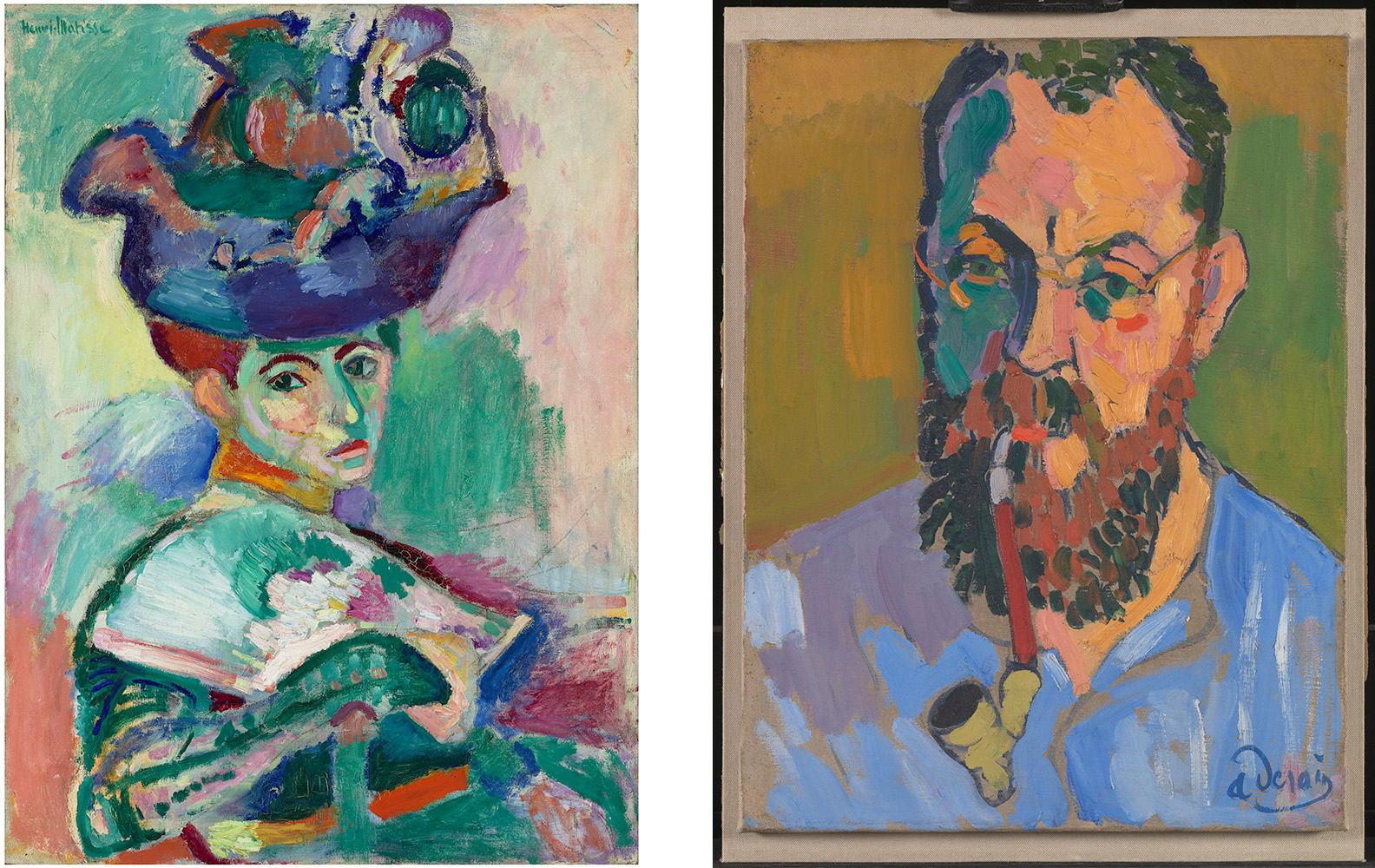
A recreated Salon d’automne in Paris frames Henri Matisse’s “Femme au chapeau” as the centerpiece of an exhibition devoted to its context. Maroon wallpaper with gold laurel wreaths, ferns, wainscotting, and period-inspired music create a salon atmosphere. The painting is prominently lit and positioned so it can be viewed from an adjacent gallery through a wall cutout. “Femme au chapeau” (1905) is reunited with three other Matisse works that would have appeared beside it at the Grand Palais debut. The subject, Amélie Matisse, was a milliner and designed her own hat. The museum has owned the painting since Elise Haas’s 1991 bequest, which requires it to remain on display and limits its ability to travel.
"“The salon” meant the re-creation of the Salon d'automne in Paris, where Henri Matisse's groundbreaking, colorful painting was first exhibited in 1905. Graceful ferns arch from pots standing in corners; the walls are lined with maroon wallpaper festooned with gold laurel wreaths inspired by the 1904 Salon d'automne (not a single photograph survives of the 1905 reprise). Wainscotting trims the walls and paintings hang side by side, where “Femme au chapeau” (1905) is reunited with three other Matisse paintings it would have been beside in its grand debut at the Grand Palais."
"The celebrity canvas occupies a starring role, prominently lit and visible from an adjacent gallery through a cutout in the wall. The subject of the painting, Matisse's wife Amélie Matisse, knew a thing or two about hats. Herself a milliner, she is wearing a hat of her own design. Turn of the century Paris was full of people plying her profession - some 1,000 milliners were employed in the city's peak hat days."
"The museum has owned the painting since Elise Haas's bequest in 1991 - it's usually on display on the second floor - but it has moved to the fourth floor to become, for the first time, the centerpiece of an entire exhibition devoted to its context. Of the roughly 30 works in the Haas bequest, Matisse's masterwork is the only one that can't travel (it must also always be on display as a stipulation of the bequest)."
"Haas likened what was certainly one of her most favorite paintings to a cocktail; no matter how tired she was, she could look at “Femme au chapeau,” and it would revive her. “Femme au chapeau” has an even longer"
Read at Mission Local
Unable to calculate read time
Collection
[
|
...
]