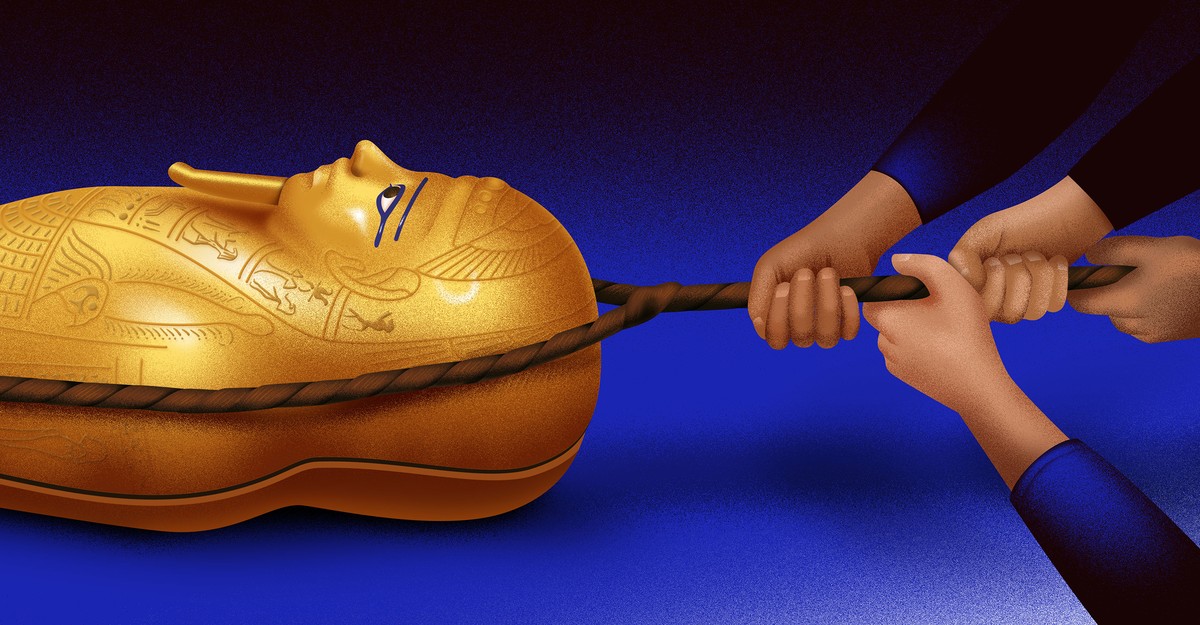
"In his speech, Macron pitched the museum as an antidote to global conflict and the legacies of imperialism. Instead of taking the greatest works of art from the lands it conquered—as Napoleon's armies had—France was now bringing its treasures east. "Beauty," Macron declared, "will save the world.""
"Two days after the museum opened, one of its beautiful objects began drawing attention from scholars, but not in the way that Macron might have hoped. It was an immaculately preserved rose-granite slab, or stele, inscribed with a royal decree from the pharaoh Tutankhamun. The stele dated to about 1318 B.C.E., closer to the boy-king's death than any other surviving monument. It stood at five and a half feet, and the engravings—Tut offers wine to the god Osiris on one side of the slab, and accepts bouquets from a priest on the other—were unlike anything scholars had previously seen."
"What puzzled experts was that a Tut stele this astonishing could emerge, as if from nowhere, a century after the British archaeologist Howard Carter discovered the pharaoh's tomb. "Does anyone know ANYTHING about this?" a Giza-based Egyptologist tweeted. The museum's label for the stele, she added, was "a masterclass in saying almost nothing.""
In November 2017, Emmanuel Macron inaugurated the Louvre Abu Dhabi, presented as a universal museum linking East and West. The project involved Emirati payments to France for the Louvre name, curatorial guidance, and loans of major artworks. Macron framed the museum as a remedy for global conflict and imperial legacies, emphasizing the movement of treasures east rather than extraction. Shortly after opening, a rose-granite stele inscribed with a royal decree attributed to Tutankhamun attracted attention. Dated to about 1318 B.C.E., it was unusually well preserved and featured engravings unlike any previously known. Scholars questioned how such a remarkable object could appear seemingly without prior documentation, given the century gap after Howard Carter’s discovery of Tutankhamun’s tomb.
Read at The Atlantic
Unable to calculate read time
Collection
[
|
...
]