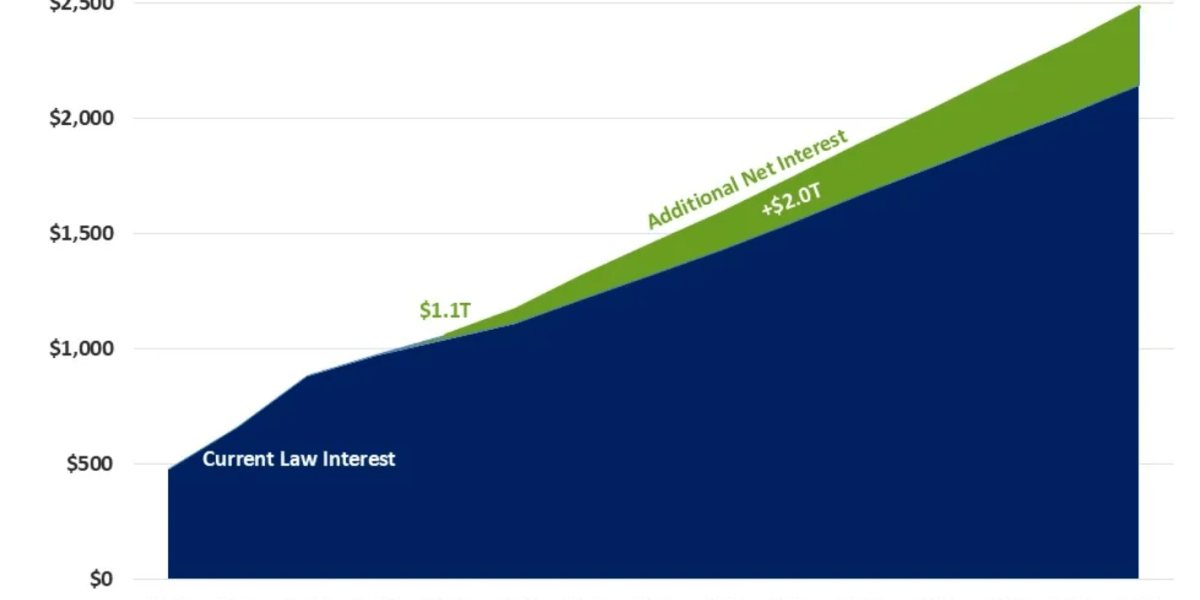
Debt interest spending is already larger than Medicaid, national defense, or all non-defense discretionary programs combined. Interest costs reached a record 3.25% of GDP and about 19% of federal revenue in fiscal year 2025. With the 30-year Treasury yield above 5.19%, a fiscal watchdog warns that elevated yields could increase interest costs from about $880 billion today to about $2.5 trillion by 2036. That would raise debt interest’s share of federal revenue to nearly 30%, close to triple its historical average. The risk is a compounding debt spiral when the average interest rate on debt exceeds economic growth, making it harder for fiscal policy to stabilize debt dynamics.
"The federal government already spends more on debt interest than on Medicaid, national defense, or all non-defense discretionary programs combined. Now, with the 30-year Treasury yield surging past 5.19% - its highest level in almost 20 years - a leading fiscal watchdog is warning that what was already a crisis could turn into something far worse."
"According to the Committee for a Responsible Federal Budget (CRFB), interest costs consumed a record 3.25% of GDP and roughly 19% of all federal revenue in fiscal year 2025. If Treasury yields remain elevated at current levels - roughly 55 basis points above Congressional Budget Office projections across the yield curve - interest costs would grow 2.5-fold, climbing from $880 billion today to $2.5 trillion by 2036."
"That would push debt interest's share of federal revenue to almost 30% - nearly triple its historical average over the past half-century. CRFB warns the real danger lies in the mechanics behind them. When the average interest rate on the national debt exceeds the economic growth rate - what economists call r>g - debt can begin rising rapidly and uncontrollably."
"Under the elevated-rate scenario, that gap would reach 75 basis points by 2036, making it increasingly difficult for even responsible fiscal policy to stop the spiral. The combination of high debt levels and a large gap between r and g can lead to a debt spiral - where rising interest costs boost debt, rising debt boosts interest rates, and rising rates boost interest costs further."
Read at Fortune
Unable to calculate read time
Collection
[
|
...
]