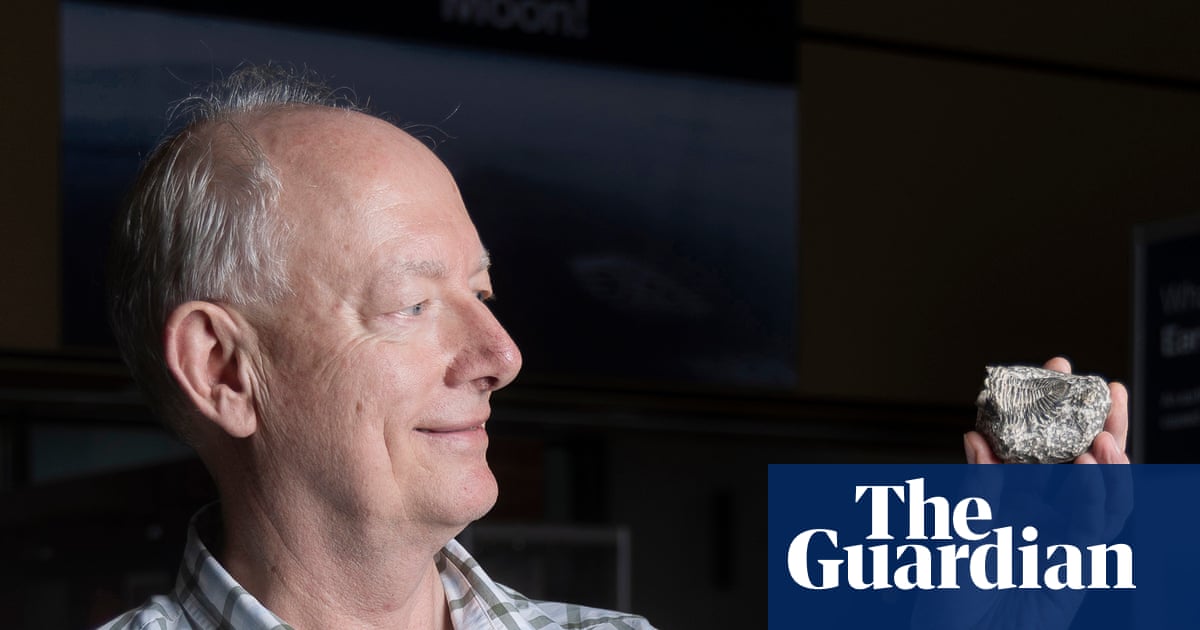
Craig Munns, now 65, works at Geoscience Australia monitoring mineral deposits while pursuing his passion for palaeontology. After leaving school as an electronics trainee, he eventually enrolled as a part-time student and graduated with honours in palaeontology from the University of New England at age 62. His current research involves analyzing drill cores extracted east of Alice Springs, studying biostratigraphy to understand the progression of specimens through rock strata. Despite owning a T rex model, Munns specializes in invertebrate fossils, particularly trilobites and other ancient organisms. He demonstrates his expertise by examining 500-million-year-old trilobite fossils, explaining their anatomical features and ecological adaptations.
"He decided to enrol as a part-time student. He graduated at 62, with honours in palaeontology from the University of New England in Armidale, NSW. Now 65, Munns works at Geoscience Australia, a government agency that conducts geoscientific research. His main task is monitoring mineral deposits, but he sounds most animated when he talks about a palaeontology paper he is working on."
"What I'm doing is looking at the biostratigraphy—the biology found at each strata, the progress of specimens or species through the strata. He explains his methodology: You chop the core up so it splits along lines where you might see a fossil."
"Munns holds up to the camera what looks like a lump of grey rock, but is actually a 500m-year-old trilobite that used to roll up into a ball to defend itself. This one has got about 30 legs, and eyes on the top of its head. It lived in the mud and could see out."
Read at www.theguardian.com
Unable to calculate read time
Collection
[
|
...
]