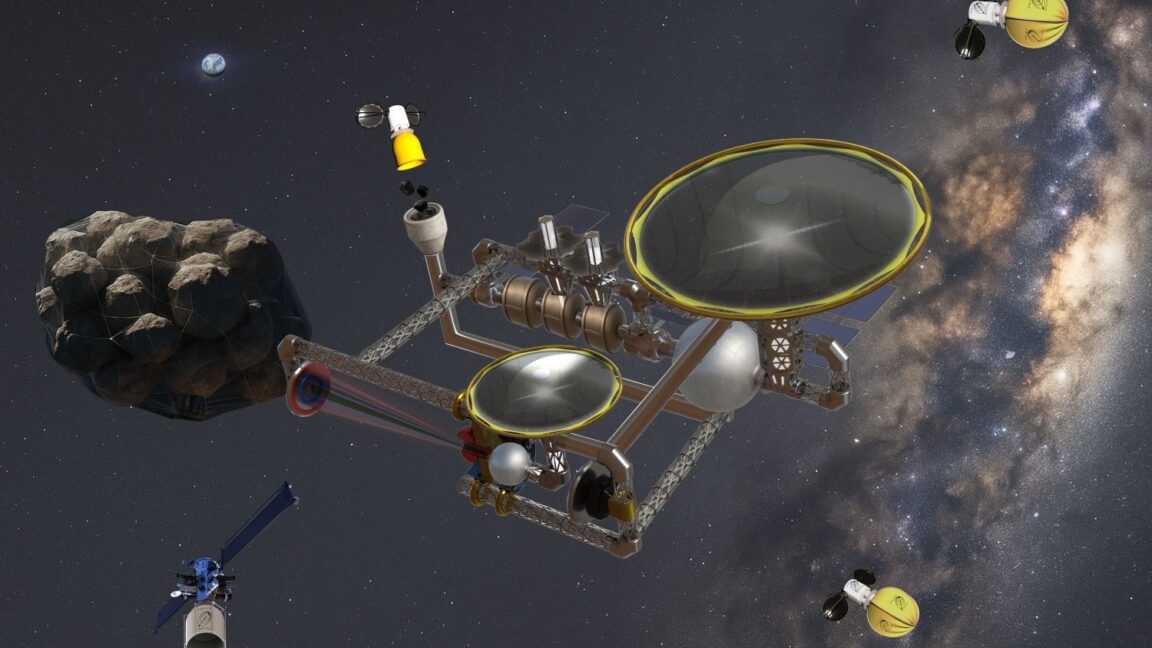
"We envision it becoming a base for robotic research and development on materials processing and manufacturing. Long term, instead of building space hardware on the ground and launching propellant up from the Earth, we could harvest it from raw materials in space."
"Sercel said there are as many as 250 potential target asteroids, with a diameter of up to about 20 meters, that could be reached with reusable, robotic spacecraft over the next decade. He envisions aggregating dozens, and then hundreds, of small asteroids at the "New Moon" processing facility, which could potentially be located at the Earth-Sun L2 point, about 1.5 million km from Earth."
"Such asteroids could provide water for use as propellant and minerals for everything from solar panels to radiation shielding. Various asteroids could be targeted for their content, such as C-type asteroids as a source of water or M-types for metals."
TransAstra, a Los Angeles-based company, has secured funding for a feasibility study of its "New Moon" mission to capture and relocate a near-Earth asteroid approximately 100 metric tons in mass. The company identifies up to 250 potential target asteroids within 20 meters diameter that could be reached by reusable robotic spacecraft over the next decade. The captured asteroids would be aggregated at a processing facility potentially located at the Earth-Sun L2 point, 1.5 million kilometers from Earth. These asteroids would serve as sources of water for propellant and minerals for solar panels, radiation shielding, and other materials. Different asteroid types would be targeted for specific resources, such as C-type asteroids for water or M-type asteroids for metals. The feasibility study, conducted with University of Central Florida, Purdue, and NASA's Jet Propulsion Laboratory, is expected to be completed by May, with a potential mission rendezvous by 2028 or 2029.
Read at Ars Technica
Unable to calculate read time
Collection
[
|
...
]