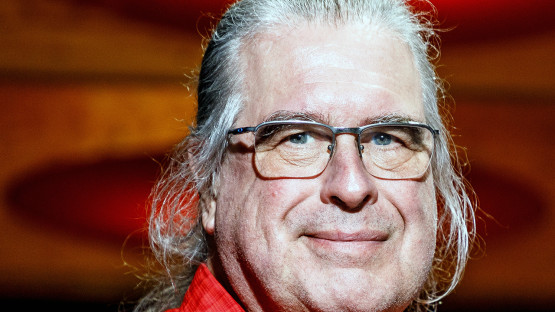
"Brassard met Bennett, a physicist at IBM Research, in 1979 while the two were swimming off the coast of Puerto Rico. Brassard was taking a break from a conference on theoretical computing, where he was presenting his graduate work on the mathematical foundations of cryptography. Bennett swam up to him and proposed an idea for a bank note that couldn't be counterfeited based on principles of quantum mechanics."
"Their collaboration led to the development of quantum cryptography - the application of quantum mechanics to encrypt, transmit and decode information securely. Their system, named BB84, used particles of light to make encryption keys that could lock and unlock digital data. Thanks to the laws of quantum mechanics, anyone who tried to hack the key would leave telltale traces the information was compromised."
"Gilles Brassard's BB84 protocol laid the foundation for quantum information science and reshaped the future of secure communication."
Gilles Brassard, a Canadian computer scientist at the University of Montreal, received his Ph.D. from Cornell in theoretical computer science. In 1979, he met physicist Charles Bennett while swimming in Puerto Rico, leading to a groundbreaking collaboration. Together they developed quantum cryptography, specifically the BB84 protocol, which uses particles of light to create encryption keys. This system leverages quantum mechanics principles to detect any unauthorized access attempts, leaving traces of compromise. Their work founded the field of quantum information science and revolutionized secure communication and computing. The 2025 Turing Award, considered computing's Nobel Prize, recognizes their contributions with a $1 million prize.
#quantum-cryptography #quantum-information-science #bb84-protocol #secure-communication #turing-award
Read at Cornell Chronicle
Unable to calculate read time
Collection
[
|
...
]