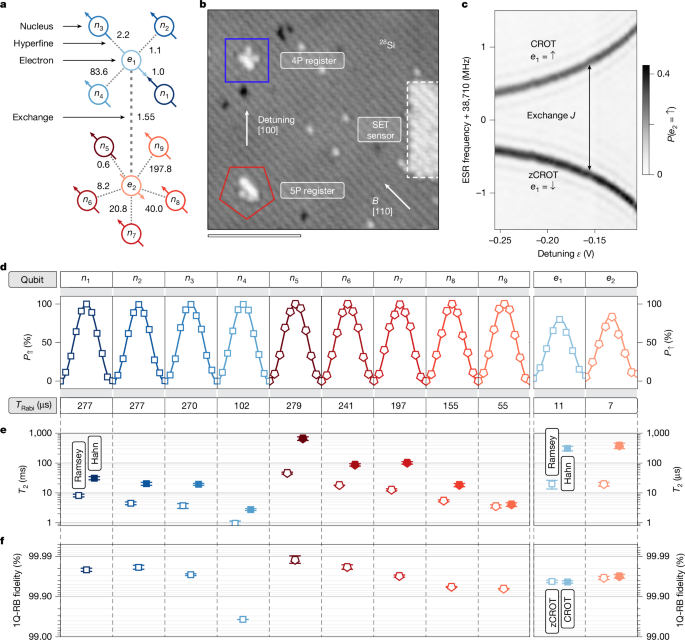
"The predominant material in modern classical computers, silicon, is also a strong contender for the practical implementation of quantum processors. To unlock the promised computational benefits of quantum computing, the qubit count needs to scale while maintaining high operation fidelity and connectivity. In terms of qubit numbers, the lead is at present held by superconducting, ion-trap and neutral-atom processors, which approach hundreds of interconnected qubits."
"quantum computing with precision-placed phosphorus atoms in silicon, which we refer to as the 14|15 platform (according to the respective positions in the periodic table), is attracting growing interest driven by industry-leading physical-level metrics with exceptional, second-long coherence times. The 14|15 platform uses precision manufacturing to place individual phosphorus atoms in close proximity (≲3 nm) to each other, in which a single loaded"
Silicon offers a promising route for scalable quantum processors due to its small footprint and compatibility with industrial manufacturing. Current platforms such as superconducting, ion-trap and neutral-atom systems lead in qubit count but face scale-up challenges in manufacturing, control miniaturization and materials engineering. Semiconductor devices now host larger arrays, yet multi-qubit control remains limited. Precision-placed phosphorus donors in silicon (the 14|15 platform) exploit close atomic spacing and a shared electron to achieve second-long coherence, ancilla-enabled QND readout, native multi-qubit gates, and nuclear-nuclear CZ operations with fidelities exceeding 99%.
Read at Nature
Unable to calculate read time
Collection
[
|
...
]