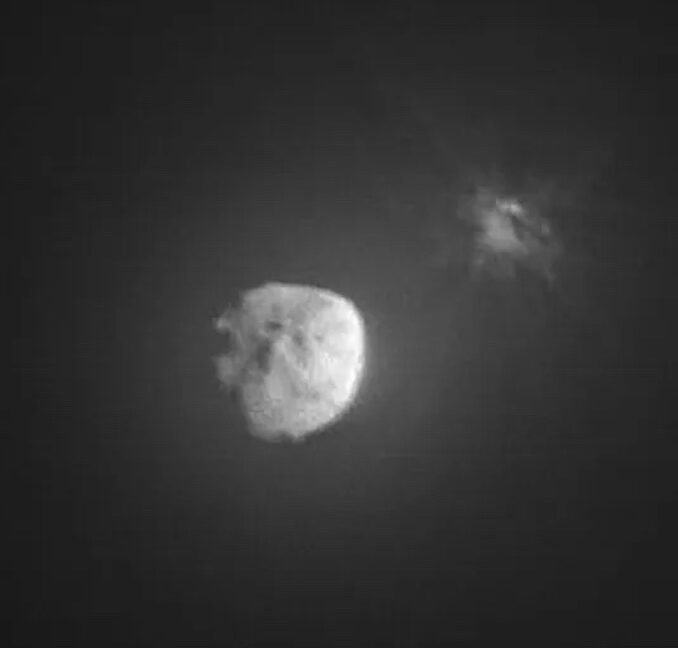
"By intentionally ramming a probe into the 160-meter-wide moonlet named Dimorphos, the smaller of the two asteroids, humanity demonstrated that the kinetic impact method of planetary defense actually works. The immediate result was that Dimorphos' orbital period around Didymos, its larger parent body, was slashed by 33 minutes."
"DART actually changed the trajectory of the entire Didymos binary system, altering its orbit around the Sun. Tracking space rocks: Measuring the orbital shift of a 780-meter-wide primary asteroid and its moonlet from millions of miles away isn't trivial. The change in the system's heliocentric trajectory was expected to be small, a minuscule nudge that would become apparent only after months or years of continuous observation."
"To find the infinitesimal deviation DART created, Makadia's team relied mostly on a technique called stellar occultation. When an asteroid passes in front of a distant star from the perspective of an observer on Earth, the star briefly blinks out. By precisely timing these blinks as they sweep across the globe, astronomers can pinpoint an asteroid's position with astonishing accuracy."
On September 26, 2022, NASA's DART spacecraft intentionally collided with Dimorphos, a 160-meter moonlet orbiting the larger asteroid Didymos. The impact reduced Dimorphos' orbital period around Didymos by 33 minutes, demonstrating that kinetic impact planetary defense is viable. Beyond this immediate effect, long-term observational data revealed that DART altered the trajectory of the entire binary system's orbit around the Sun. Researchers led by Rahil Makadia at the University of Illinois Urbana-Champaign used stellar occultation techniques to measure this infinitesimal orbital shift. Between October 2022 and March 2025, astronomers captured 22 stellar occultations of the Didymos system to precisely determine the impact's consequences on the system's heliocentric trajectory.
Read at Ars Technica
Unable to calculate read time
Collection
[
|
...
]