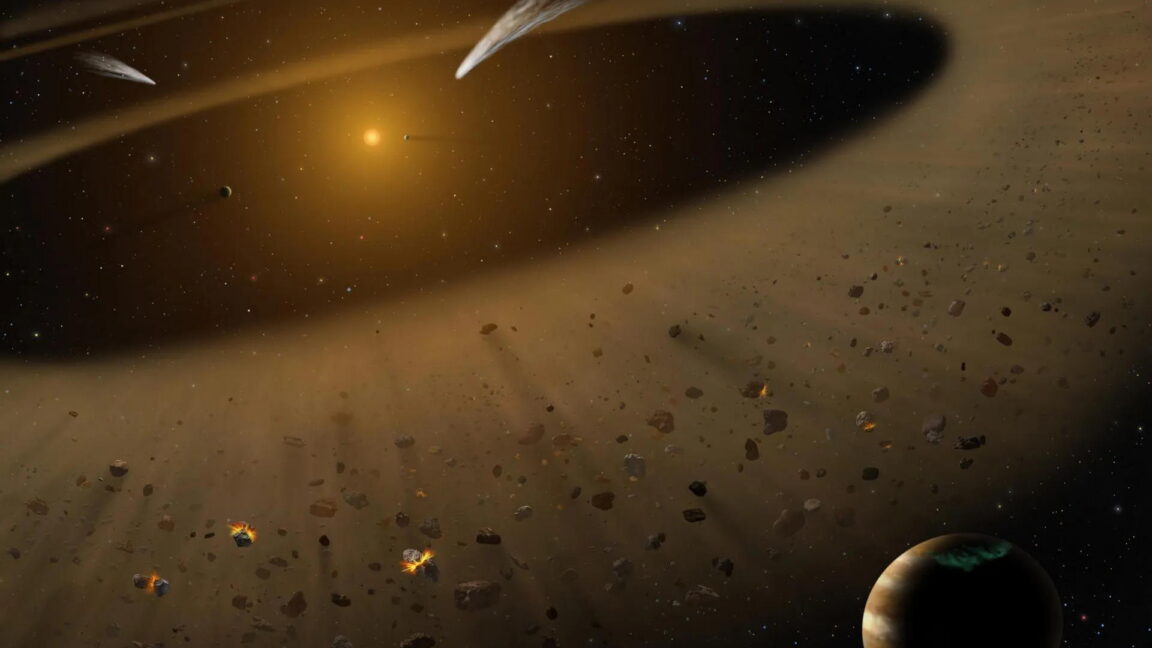
"Over the past 30 years, astronomers have cataloged about 4,000 Kuiper Belt objects (KBOs), including a smattering of dwarf worlds, icy comets, and leftover planet parts. But that number is expected to increase tenfold in the coming years as observations from more advanced telescopes pour in. In particular, the Vera C. Rubin Observatory in Chile will illuminate this murky region with its flagship project, the Legacy Survey of Space and Time (LSST), which began operating last year."
""Beyond Neptune, we have a census of what's out there in the solar system, but it's a patchwork of surveys, and it leaves a lot of room for things that might be there that have been missed," says Renu Malhotra, who serves as Louise Foucar Marshall Science Research Professor and Regents Professor of Planetary Sciences at the University of Arizona."
The Kuiper Belt lies beyond Neptune as a vast region of frozen debris roughly 30–50 astronomical units from the sun and possibly extending farther. Astronomers have cataloged about 4,000 Kuiper Belt objects, including dwarf worlds, icy comets, and leftover planetary fragments. Upcoming observatories—especially the Vera C. Rubin Observatory's LSST and the James Webb Space Telescope—will dramatically increase detections, potentially by an order of magnitude. Improved surveys will fill gaps in current, patchwork observations and enable study of unseen planets, the belt's true extent, and signatures of past collisions or interstellar encounters preserved among these largely pristine relics.
Read at Ars Technica
Unable to calculate read time
Collection
[
|
...
]