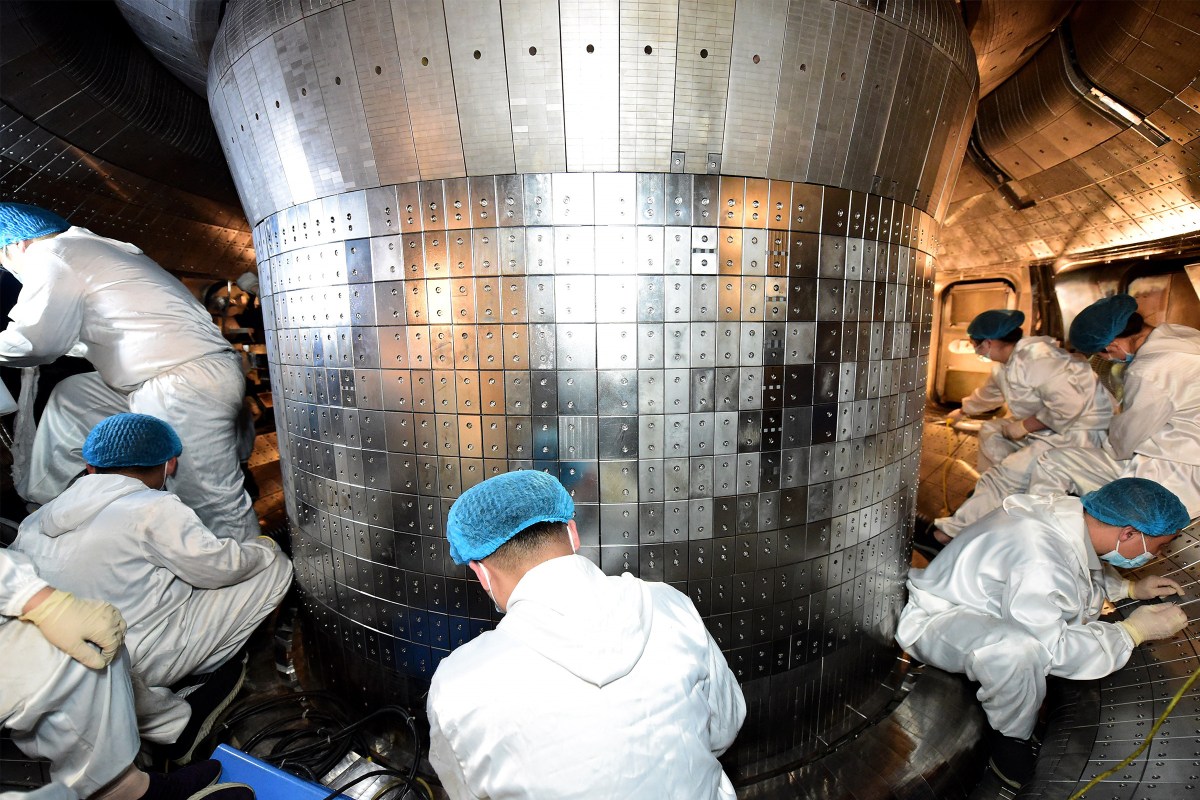
"Scientists at China's Experimental Advanced Superconducting Tokamak (EAST) program rang in the new year with a stunning accomplishment: empirical evidence that they used the device to achieve nuclear plasma densities once thought to be beyond human capabilities. On January 1, researchers at the Hefei Institutes of Physical Science at the Chinese Academy of Sciences published a wild new study in the journal Science Advances."
"One difficulty, however, is that all atomic nuclei have a positive charge, meaning they're naturally repulsed by each other - think two magnets with opposite poles. To give atomic nuclei enough kinetic energy to combine into one, scientists must heat the fuel into a super-dense plasma at about 150 million kelvin, or 27 million degrees Fahrenheit, the researchers explained in a press release."
EAST produced plasma densities well above previously accepted limits by creating a high gas-pressure environment inside the tokamak before initiating the plasma. The pre-filled gas cushions plasma-wall interactions, reducing destructive contact and enabling denser plasma confinement. The approach allowed sustained hot, dense, and stable conditions necessary for fusion, challenging the traditional Greenwald limit that linked higher density to instability. Achieving fusion-grade temperatures near 150 million kelvin remains essential to overcome electrostatic repulsion between nuclei. The method points to a practical route for improving plasma stability and advancing efforts toward self-sustaining fusion energy.
Read at Futurism
Unable to calculate read time
Collection
[
|
...
]