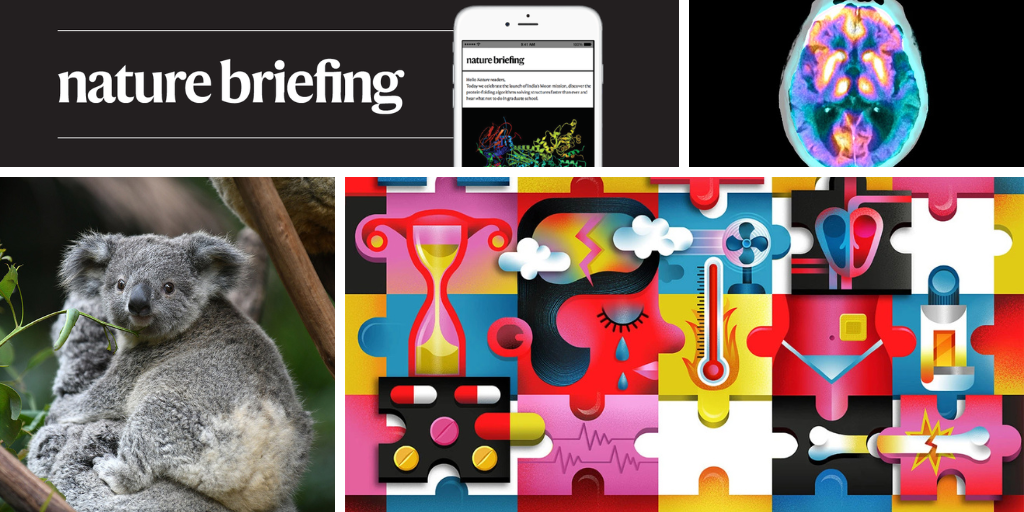
"Koalas in Victoria, Australia recovered from a severe genetic bottleneck through an increase in recombination - a process in which the DNA from two parents gets shuffled to form new sequences in their offspring - during a rapid population expansion. The findings suggest that even species pushed to the brink of extinction can recover lost genetic diversity."
"Tanycytes - specialized cells that clear toxic proteins from the brain - malfunction in people with Alzheimer's disease, which leads to the build-up of abnormal tau proteins that characterizes the condition. Researchers found that less tau had moved from the CSF to the bloodstream in people with Alzheimer's compared with people who did not have the disease."
"Chemists have synthesized a new type of carbon-based molecule with an unprecedented twist in its structure. The team calls the looped molecule a 'half-Möbius', inspired by the Möbius strip - a twisted loop with one continuous surface. In the half-Möbius molecule, the chain of atoms is twisted by 90° to make the loop."
Koalas in Victoria, Australia have recovered genetic diversity despite a population collapse exceeding 90%, with the number of breeding individuals substantially increasing in recent decades. This recovery occurred through recombination, where DNA from two parents shuffles to create new sequences in offspring. Additionally, research reveals that tanycytes—brain cells responsible for clearing toxic proteins—malfunction in Alzheimer's disease patients, allowing abnormal tau proteins to accumulate. Chemists have also synthesized a novel carbon-based molecule called a 'half-Möbius,' featuring a 90-degree twist inspired by Möbius strips, representing an unprecedented molecular structure.
Read at Nature
Unable to calculate read time
Collection
[
|
...
]