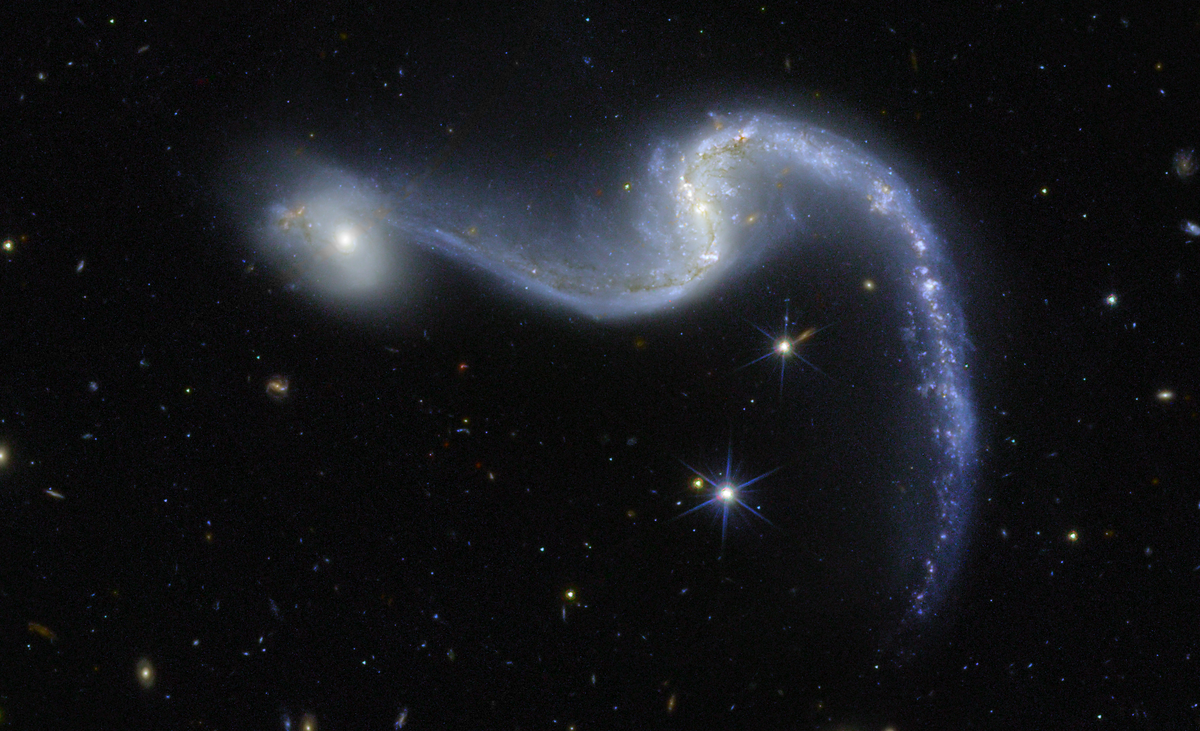
Euclid launched in 2023 on a six-year mission to map the cosmos, observing billions of galaxies out to about 10 billion light-years. The survey aims to reveal how galaxies form and evolve and to trace the universe's expansion over 13.8 billion years. The mission seeks evidence about dark matter's gravitational effects and dark energy's role in accelerating cosmic expansion. Euclid's first formal data release, covering about 14 percent of the final survey area, will occur next year. The telescope produced a striking image of spiral galaxy NGC 646, about 392 million light-years distant; a nearby-looking galaxy, PGC 6014, is actually ~45 million light-years closer.
"A languid spiral galaxy appears draped against deep space in a stunning new image from the European Space Agency's Euclid telescope. Euclid launched in 2023 on a six-year mission to map the cosmos at scale, observing billions of galaxies stretching as far away as 10 billion light-years from Earth. The effort could reveal how galaxies form and evolve and how the universe has expanded over its 13.8-billion-or-so-year history."
"In turn, astronomers hope Euclid will shed light on dark matter, which we know tugs at normal matter but is utterly invisible to us, and dark energy, the force that is responsible for accelerating the speed at which the universe expands. On supporting science journalism If you're enjoying this article, consider supporting our award-winning journalism by subscribing. By purchasing a subscription you are helping to ensure the future of impactful stories about the discoveries and ideas shaping our world today."
Read at www.scientificamerican.com
Unable to calculate read time
Collection
[
|
...
]