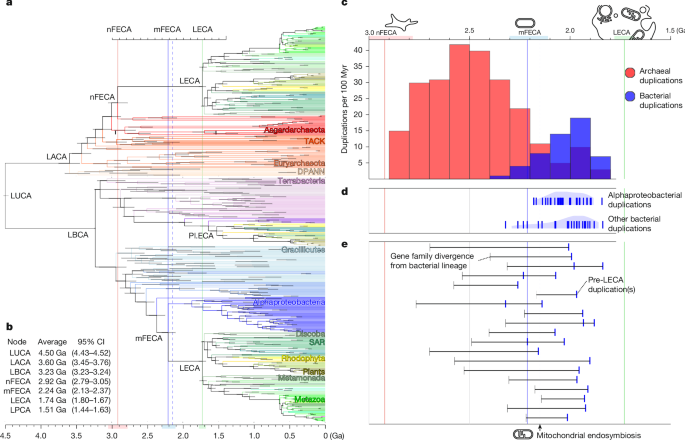
"The origin of eukaryotes was a formative event in the history of life, in which a new kind of cell with distinct functional, morphological and ecological modalities evolved through an evolutionary merger between at least two prokaryotes: an Asgard archaeal host and an alphaproteobacterial endosymbiont1,2,7,10,11. How and when eukaryotes originated, and the order in which the eukaryotic characteristics evolved, are the subject of intense debate2."
"Other points of difference include the number of endosymbiotic partners involved in eukaryogenesis. Although most hypotheses agree on archaeal and alphaproteobacterial ancestry, the syntrophy hypothesis includes an additional, ∂-proteobacterial partner, which is suggested to have served as the host to an endosymbiotic Asgard archaeon (the future nucleus), to explain the bacterial character of the eukaryotic membrane7; in such a scenario the alphaproteobacterial ancestor of the mitochondrion entered the symbiosis at a later stage."
Eukaryotes originated through a merger between at least two prokaryotes: an Asgard archaeal host and an alphaproteobacterial endosymbiont. Competing hypotheses differ on the timing of mitochondrial acquisition and whether mitochondrial entry was prerequisite to other eukaryotic innovations. Hypotheses also differ on the number and identity of endosymbiotic partners, with the syntrophy hypothesis invoking an additional ∂-proteobacterial partner that hosted an Asgard archaeon and the serial endosymbiosis hypothesis invoking multiple transient bacterial partners before mitochondrial endosymbiosis. Determining the order of eukaryotic trait emergence can use gene acquisition timing, but gene trees lack a clear node for mitochondrial acquisition, complicating age estimates.
Read at Nature
Unable to calculate read time
Collection
[
|
...
]