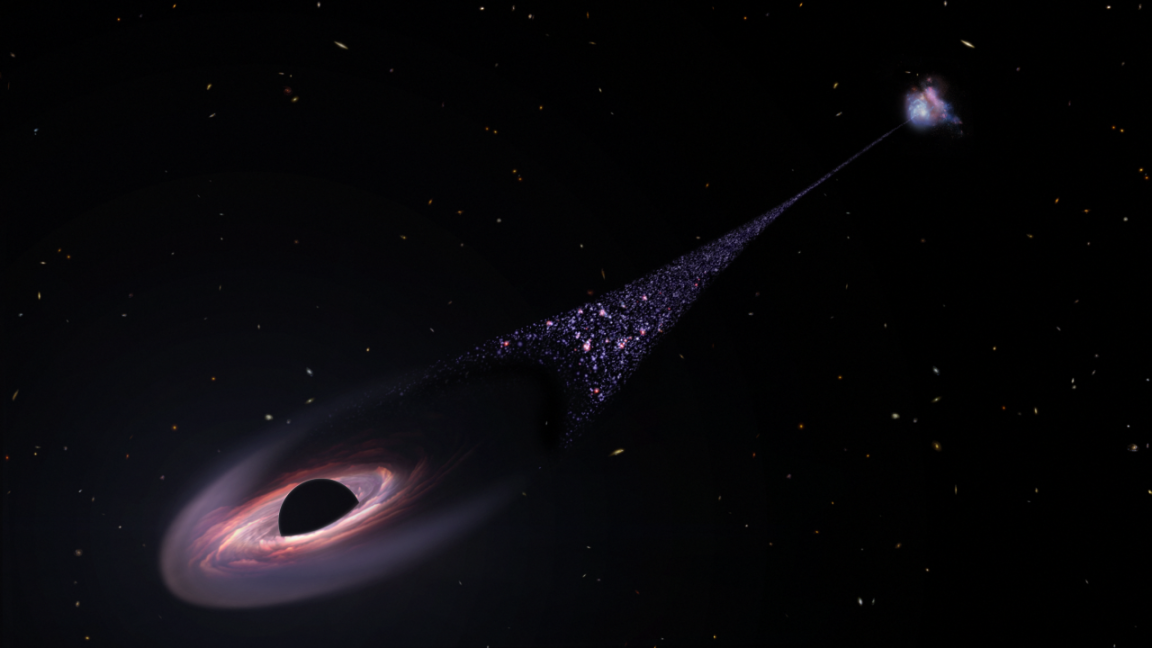
"When the James Webb Space Telescope sent its first high-definition infrared images back to Earth, astronomers noticed several tiny, glowing, crimson stains. These objects, quickly named "Little Red Dots," were too bright to be normal galaxies, and too red to be simple star clusters. They appeared to house supermassive black holes that were far more massive than they had any right to be."
""They were too massive, since we saw they'd have to be completely filled with stars," says Vadim Rusakov, an astronomer at the University of Manchester and lead author of the study. "They would need to produce stars at 100 percent efficiency, and that's not what we're used to seeing. Galaxies cannot produce stars at more than 20 percent efficiency, at least that's what our current knowledge is.""
The James Webb Space Telescope imaged tiny, glowing crimson objects labeled Little Red Dots that were too bright for normal galaxies and too red for simple star clusters. Compact-galaxy explanations require unrealistically high star-formation efficiency, up to 100 percent versus the observed limit near 20 percent. The objects also conflict with the typical galaxy–black-hole mass ratio of about 0.1 percent, appearing overmassive. A study proposes that young supermassive black holes pass through a cocoon phase, growing while embedded in high-density gaseous cocoons. Those cocoons would emit infrared light and could account for the Little Red Dots.
Read at Ars Technica
Unable to calculate read time
Collection
[
|
...
]