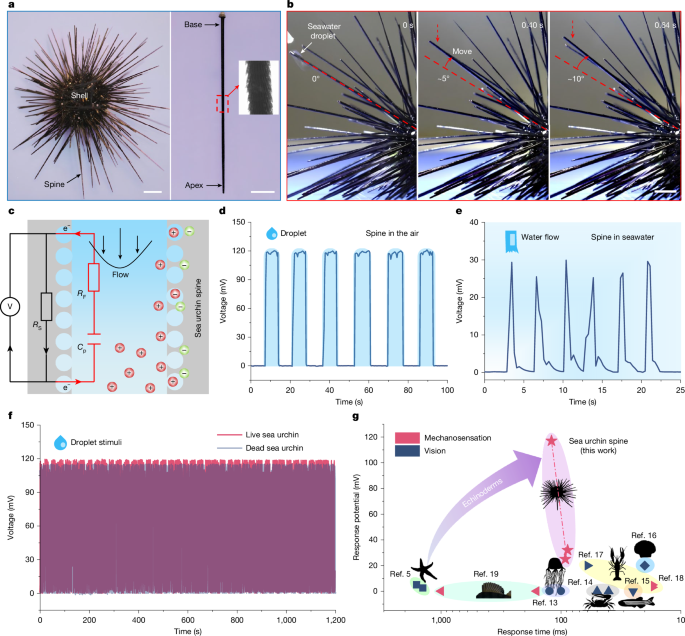
Cellular solids like wood and bone exhibit excellent mechanical properties and energy absorption, inspiring engineered microarchitectured materials. Natural cellular structures may have evolved for purposes beyond mechanical defense, with mechanisms yet to be fully understood. Sea urchin spines demonstrate a previously unexplored mechanoelectrical perception behavior, responding independently to tactile stimuli. When exposed to mechanical disturbance, such as a seawater droplet, individual spines rotate approximately 10 degrees within one second, while unexposed neighboring spines remain unresponsive. High-speed imaging reveals response times of approximately 88 milliseconds, indicating sophisticated sensory capabilities in these biomineralized structures.
"Cellular solids (also known as structural foams) are ubiquitous in natural and engineered systems, such as wood, trabecular bone, energy storage and catalysts, owing to their excellent mass transport, mechanical properties and energy absorption. Recent efforts have been dedicated to developing cellular microarchitected materials inspired by natural systems with extraordinary mechanical strength and damage tolerance."
"It is notable that these natural cellular solids may not have primarily evolved for improved mechanical properties, but rather may be a by-product of the complex biomineralization process. Uncovering previously unknown mechanisms beyond their traditionally recognized function of mechanical defence is essential for comprehensively understanding and using these naturally formed cellular solids."
"In situ observations of a living D. setosum demonstrate that its spines have independent and highly responsive tactile perception abilities. On dropping a seawater droplet onto the apex of a spine, a swift and noticeable rotation of approximately 10° relative to the body shell axis occurs within 1 s. The response time of the mechanoelectrical perception of the spine is approximately 88 ms."
#cellular-solids #sea-urchin-biomechanics #mechanoelectrical-perception #biomineralization #tactile-sensing
Read at Nature
Unable to calculate read time
Collection
[
|
...
]