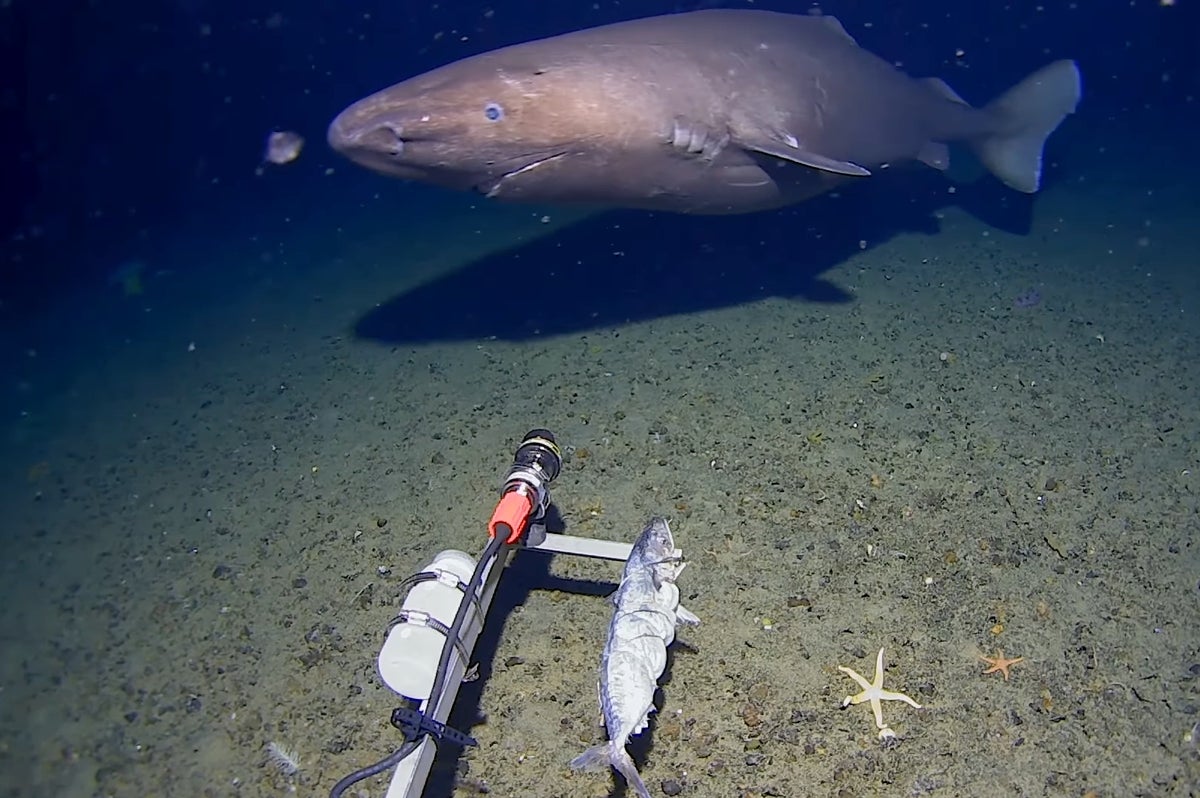
"Researchers at the Minderoo-UWA Deep-Sea Research Centre watch footage of what is likely a southern sleeper shark swimming into view off Antarctica's South Shetland Islands. Join Our Community of Science Lovers!Sign Up for Our Free Daily Newsletter A rare encounter with a southern sleeper shark in the deep, chilly waters of Antarctica's Southern Ocean has scientists reimagining what fauna might live in such a harsh, extreme environment."
"Footage of the shark was captured in January 2025 by a baited deep-sea camera in a trench at about 490 meters beneath the sea surface off the South Shetland Islands. The camera was set by the MinderooUniversity of Western Australia (UWA) Deep-Sea Research Center. During the shark's surprise appearance, marine geoscientist and center member Heather Stewart can be heard asking, What is that that sneaks on in the background? On supporting science journalism If you're enjoying this article, consider supporting our award-winning journalism by subscribing."
"That was certainly very unexpected, Stewart said. This is the most southerly report of a southern sleeper shark (Somniosus antarcticus), according to the researchers at the center. These deep-sea predators, which survive on a diet of cephalopods, ray-finned fish, and even some mammals and birds, can live for 250 to 300 years, according to the center. The Associated Press reported that this individual spanned between three and four meters in length."
Footage captured in January 2025 by a baited deep-sea camera recorded a likely southern sleeper shark in a trench about 490 meters beneath the sea surface off the South Shetland Islands. The camera was deployed by the Minderoo–University of Western Australia Deep-Sea Research Center. The sighting represents the most southerly report of Somniosus antarcticus. Southern sleeper sharks feed on cephalopods, ray-finned fish, and occasionally mammals and birds, and individuals can live for 250 to 300 years. The observed shark measured about three to four meters and is thought to be female due to a lack of claspers. The encounter suggests sharks inhabit Antarctic deep waters.
Read at www.scientificamerican.com
Unable to calculate read time
Collection
[
|
...
]