Hyperfine structure measurements in atomic hydrogen achieved high precision and provided evidence for the electron’s anomalous magnetic moment while advancing quantum electrodynamics. In antihydrogen, ground-state hyperfine splitting tests CPT symmetry and complements comparisons of 1S–2S transition frequencies. Hyperfine splitting is sensitive to antiproton internal structure through Zemach correction and nuclear polarizability at the tens-of-ppm level. A prior inference of the 2S hyperfine splitting relied on combining 1S–2S laser spectroscopy with earlier ground-state hyperfine splitting, with precision limited by the ground-state value. Measuring both 2S and 1S hyperfine splittings allows determination of the Sternheim interval, (8a2S−a1S)/h, which is largely insensitive to nuclear-structure effects and probes higher-order QED effects. Experiments use the ALPHA-2 apparatus at CERN’s Antiproton Decelerator, where cooled antiproton and positron plasmas are merged to form antihydrogen in a magnetic potential well.
"The observation of hyperfine structure in atomic hydrogen and the high-precision measurements of its zero-field ground-state splitting, at the level of seven parts in 10 13 (1 mHz absolute uncertainty)11,18,19, were landmark achievements. These results provided the first evidence of the anomalous magnetic moment and advanced quantum electrodynamics of the electron. In antihydrogen, measurement of the ground-state hyperfine splitting offers a powerful test of CPT symmetry, complementary to comparison of the 1S-2S transition frequencies measured with Doppler-free two-photon spectroscopy20."
"The hyperfine splitting frequency is a particularly sensitive probe of the internal structure of the antiproton through the Zemach correction and nuclear polarizability at the level of 40 parts per million (ppm) (refs. 16,21). Recently, the 2S hyperfine splitting of antihydrogen was inferred by combining laser spectroscopy of the 1S-2S transition with our previous determination of the ground-state hyperfine splitting14. However, the precision was strongly limited by the latter."
"Finally, precision measurements of the 2S and 1S hyperfine splittings can be combined to determine an experimental value for the Sternheim interval22 in antihydrogen, (8{a}_{2S}-{a}_{1S})/h, which is largely insensitive to nuclear-structure effects and provides a means to probe high-order quantum electrodynamic (QED) effects16."
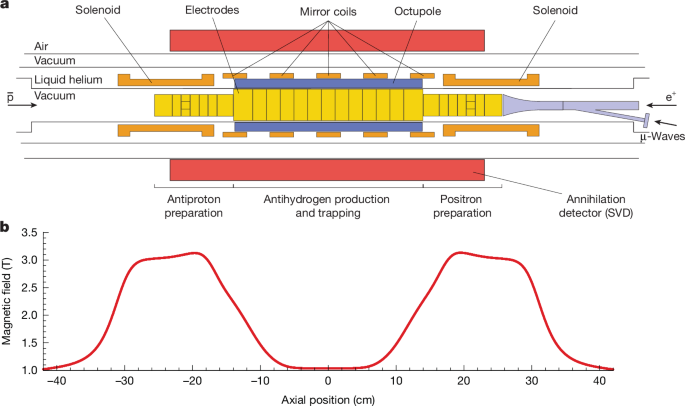
"Our experiments are conducted at the CERN Antiproton Decelerator facility using the previously described ALPHA-2 antihydrogen apparatus23. Key elements of this device are shown in Fig. 1a. Antiproton (p̄) and positron (e+) plasmas held in a cylindrical Penning-Malmberg trap24 are cooled, radially compressed and merged to synthesize antihydrogen. The latter occurs in a 0.54-K-deep magnetic potential well, in which (neutral) anti-atoms in appropriate spin states and with sufficiently low kinetic energy a"
Read at Nature
Unable to calculate read time
Collection
[
|
...
]