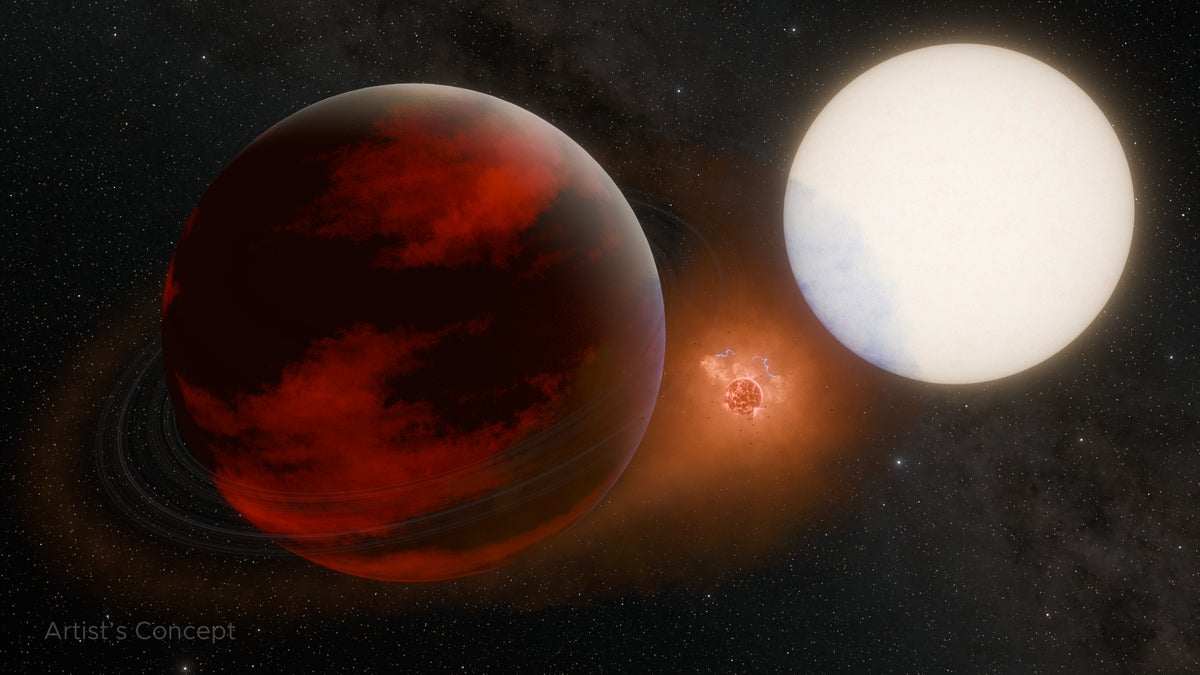
"While Earth only has the one, Jupiter has about 100 that we know of (and likely hundreds more, depending on what you define as a moon, that is). Saturn has almost 275! Many of these moons are huge; Saturn's Titan and Jupiter's Ganymede are both about the size of Mercury, and if they orbited the sun on their own, we'd be sorely tempted to call them planets in their own right."
"So moons and rings alike seem to be easy for giant planets to make—at least around the sun. Presumably this holds true for the myriad large worlds we've discovered orbiting other stars; many of these exoplanets should have exomoons and exorings, too. But could we detect them? The answer, so common with astronomy, is maybe."
"We can't see them directly—they're too faint and too close to their parent planets to resolve—but their presence can be inferred. One of the most noteworthy exomoon candidates, Kepler-1625b I, was first identified in 2017. The year before, astronomers had discovered its exoplanet via the transit method: we happen to see the planet's orbit edge on, so once per orbit, we can see the planet passing—transiting—directly in front of its star, creating a mini eclipse."
Giant planets in our solar system possess numerous moons and rings. Jupiter has approximately 100 known moons with potentially hundreds more, while Saturn has nearly 275 moons and the most prominent ring system. Some moons like Titan and Ganymede rival Mercury in size. All four giant planets—Jupiter, Saturn, Uranus, and Neptune—have ring systems, though Saturn's are most visible. These features likely exist around exoplanets orbiting other stars. Detecting exomoons and exorings presents challenges due to their faintness and proximity to parent planets. Astronomers have identified several exomoon candidates using indirect methods. The transit method, which observes planets passing in front of their stars, creates characteristic dips in light curves that can reveal moon presence.
Read at www.scientificamerican.com
Unable to calculate read time
Collection
[
|
...
]